Why This Decision Is Harder Than It Looks
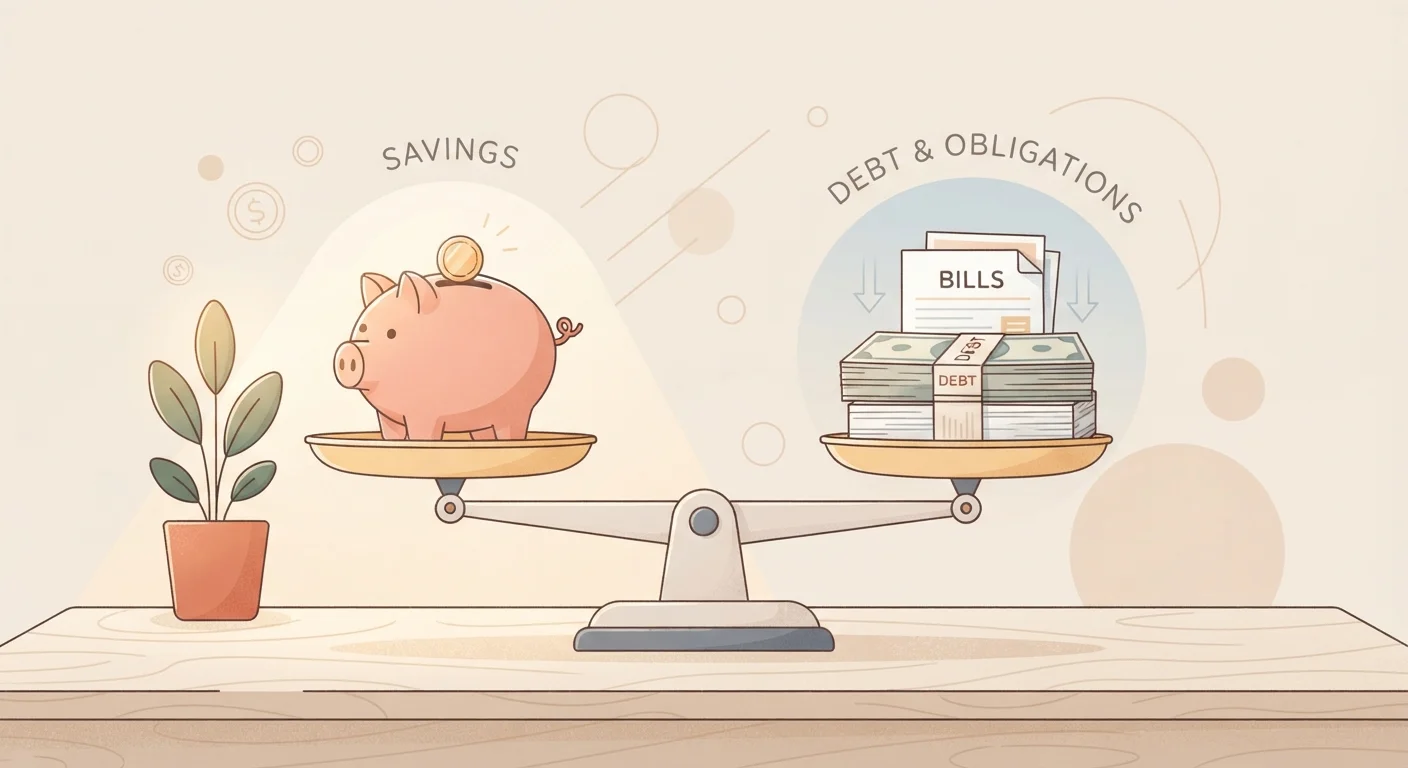
Most personal finance advice presents this as a simple choice: pay off debt first because interest rates are high, or save first because emergencies are unpredictable. The honest answer is that neither rule applies universally - your income, debt type, and risk tolerance all shape the right move.
The deeper problem is that the two goals can work against each other. Every dollar directed toward debt is a dollar not available if your car breaks down. Every dollar sitting in savings is a dollar not reducing a 24% APR credit card balance. Understanding the mechanics of each option - not just the slogans - is what leads to a sound decision. For a broader look at how saving and debt reduction interact, see our comprehensive overview of saving and debt management.
| Criterion | Emergency Fund | Paying Off Debt |
|---|---|---|
| Primary benefit | Protects against new debt | Reduces ongoing interest costs |
| Best when | No savings cushion exists | Carrying high-interest balances |
| Financial return | Low (savings account yield) | High (equals the interest rate avoided) |
| Liquidity | High - cash is accessible | Low - paid funds aren't retrievable |
| Risk if skipped | Emergency forces new debt | Interest compounds, balance grows |
| Time to feel impact | Immediate peace of mind | Gradual as balances drop |
| Recommended starting target | $500-$1,000 starter fund | Highest-rate balance first |
The Case for Building an Emergency Fund First
An emergency fund acts as a firewall. Without one, an unexpected expense - a medical bill, job loss, appliance failure - typically lands on a credit card, adding to the debt you're trying to eliminate. This is the cycle that keeps many households stuck.
Many financial educators suggest starting with a modest target (commonly $500-$1,000) rather than the full three-to-six month cushion, precisely because a small buffer provides meaningful protection without delaying debt repayment for years. Once that starter fund is in place, the risk of debt snowballing from a single emergency drops sharply.
Emergency funds matter most when your income is variable, your job security is uncertain, or your household has limited access to credit. To understand what constitutes a genuine financial emergency and how to size your fund appropriately, see what an emergency fund really means and how much is enough. If you're starting from scratch, building your first emergency fund from scratch offers a practical step-by-step approach.
~57%
Americans unable to cover a $1,000 emergency
Bankrate's annual emergency savings report has consistently found that a majority of U.S. adults could not cover a $1,000 unexpected expense from savings alone.
20%+
Average credit card APR in the U.S.
Federal Reserve data has shown average credit card interest rates exceeding 20% in recent years, making high-interest debt exceptionally costly to carry.
3-6 months
Recommended full emergency fund coverage
Most mainstream financial guidance, including from the Consumer Financial Protection Bureau, suggests three to six months of essential expenses as a target.
The Case for Paying Off Debt First
Paying off high-interest debt is one of the few places in personal finance where the math is nearly unambiguous. If you're carrying a credit card balance at 22% APR, eliminating that debt delivers the equivalent of a 22% guaranteed return - something no conventional savings account or low-risk investment can match.
The psychological dimension also matters. Research on debt repayment behavior consistently shows that reducing balances improves financial confidence and motivates continued progress. Methods like the debt avalanche (targeting highest-interest balances first) or the debt snowball (targeting smallest balances first) both produce results - the key is consistent execution. You can compare those strategies in detail in our comparison of the avalanche and snowball methods.
It's also worth examining common beliefs about early repayment before committing to a strategy. Common misconceptions about paying off debt early addresses credit score concerns and prepayment questions that often cause unnecessary hesitation.
The Hybrid Approach: Why Most People Do Both
For most households, a staged strategy outperforms either extreme. A widely referenced framework goes like this: build a small starter emergency fund, then attack high-interest debt aggressively, then grow the emergency fund to a full three-to-six months of expenses once debt is under control.
This approach acknowledges that the real risk isn't choosing saving over debt repayment - it's being so focused on one that you become financially fragile in another direction. A modest cash buffer makes it far less likely you'll reach for a credit card mid-repayment plan.
Pairing this strategy with a structured budgeting method can significantly improve follow-through. Budgeting approaches like zero-based and pay-yourself-first are worth reviewing to find a system that keeps both goals funded automatically. The pay-yourself-first principle in particular can help you allocate to savings before discretionary spending takes over.
What About Low-Interest Debt?
Not all debt demands the same urgency. A federal student loan at 5% or a mortgage at 6% poses a very different mathematical case than a 24% credit card. For lower-rate debt, the argument for prioritizing savings - or even investing - becomes much stronger. Always compare the interest rate on the debt to the realistic after-tax return you'd get from the alternative use of those funds before deciding.
This article is for general informational and educational purposes only and does not constitute personalized financial advice. Consult a qualified financial professional for guidance specific to your situation.