
Why Most Study Habits Miss the Point
Most people study by re-reading notes, highlighting passages, or watching the same lecture twice. These methods feel productive - they create a comfortable sense of familiarity with the material. The problem is that familiarity isn't the same as memory. Recognising something when you see it is far easier than retrieving it when you need it.
This gap between recognition and recall explains why students can feel well-prepared and still blank on an exam. The difference between passive and active learning strategies is significant - and passive habits dominate most people's routines simply because they require less mental effort in the moment.
Active recall directly targets this weakness. By forcing your brain to reconstruct information without looking at the source, you exercise the exact mental pathway you'll need when applying that knowledge later.
“Retrieval practice - recalling facts or concepts from memory - is a more effective learning strategy than reviewing material. The act of retrieval itself enhances long-term retention.”
— Henry L. Roediger III, Cognitive psychologist and memory researcher, Washington University in St. Louis
The Research Behind Retrieval Practice
The evidence supporting active recall is among the most replicated in cognitive psychology. Studies published over several decades consistently show that students who test themselves on material retain significantly more over time than students who spend the same amount of time re-reading. This is known as the testing effect or retrieval practice effect.
One influential line of research - associated with psychologists Henry Roediger and Jeffrey Karpicke - demonstrated that students who practiced retrieval after reading retained substantially more material a week later compared to those who re-read the same content. Crucially, the retrieval group outperformed re-readers even when they were given more review time.
~50%
More material retained with retrieval practice
Research by Roediger and Karpicke (2006, Psychological Science) found that students who used retrieval practice retained roughly 50% more material after a week compared to students who only re-studied.
2 of 3
Students overestimate passive study effectiveness
Surveys of student study strategies consistently find that re-reading is the most commonly used method, despite being among the least effective according to cognitive psychology research reviews.
Understanding how adults actually learn new skills helps explain why: memory traces are strengthened not by exposure but by the effort of reconstruction. Each successful retrieval slightly modifies the memory, making it easier to access in the future.
Practical Methods You Can Start Using Today
Active recall doesn't require any special tools. The following methods range from low-effort to more structured, and all engage the same core mechanism - effortful retrieval.
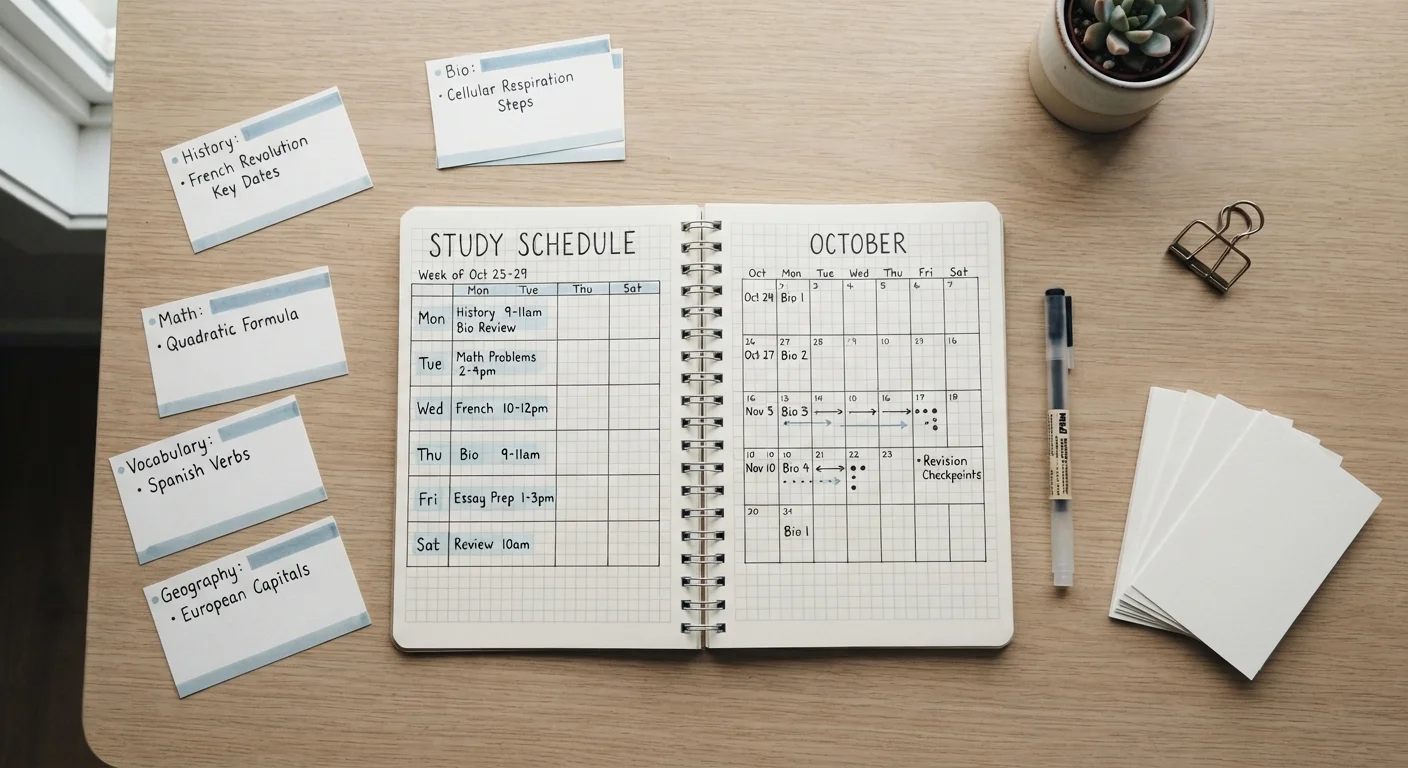
- Flashcards: Write a question on one side, the answer on the other. Quiz yourself before checking. Digital flashcard systems can be combined with spaced repetition scheduling - see how spaced repetition compares to massed practice for guidance on timing intervals.
- Free recall writing: After reading a chapter or watching a lecture, close everything and write down everything you can remember. Compare your notes to the source afterward to identify gaps.
- The blank page method: Take a topic you've studied and reproduce its key ideas, definitions, and structure from scratch on an empty page.
- Practice questions: Use end-of-chapter questions, past exam papers, or self-generated questions. Attempting a question before reviewing the answer is what activates the retrieval mechanism.
- Teach it aloud: Explain a concept out loud as if to someone unfamiliar with it. Gaps in your explanation reveal gaps in your understanding.
Start with the Question, Not the Answer
When creating flashcards or study questions, always attempt to answer before flipping or revealing the response. Even a few seconds of effortful thinking before seeing the answer amplifies the memory benefit compared to simply reading question and answer together. The struggle is the mechanism.
Getting an answer wrong during practice isn't wasted effort - it primes your brain to encode the correct information more deeply when you look it up immediately afterward. The struggle itself has value.
Fitting Active Recall Into a Realistic Study Routine
A common barrier is time. Active recall feels slower than re-reading because it is - at first. You won't get through as many pages in an hour. But because retention is dramatically stronger, you need fewer total repetitions to reach the same level of mastery. Over a full study cycle, the approach saves time while improving outcomes.
A workable structure: spend roughly one-third of your study time on input (reading, watching, listening) and two-thirds on retrieval practice. Start each session by recalling what you covered last time before introducing new material. This opening retrieval acts as both review and memory reinforcement.
Sleep also matters here. Memory consolidation during sleep means that material practiced shortly before rest tends to be retained more effectively - making late-night retrieval sessions more productive than late-night re-reading marathons.
For a broader view of how high-retention learners structure their habits, the habits of people who learn quickly across domains illustrates how retrieval practice fits into a wider system of deliberate learning.