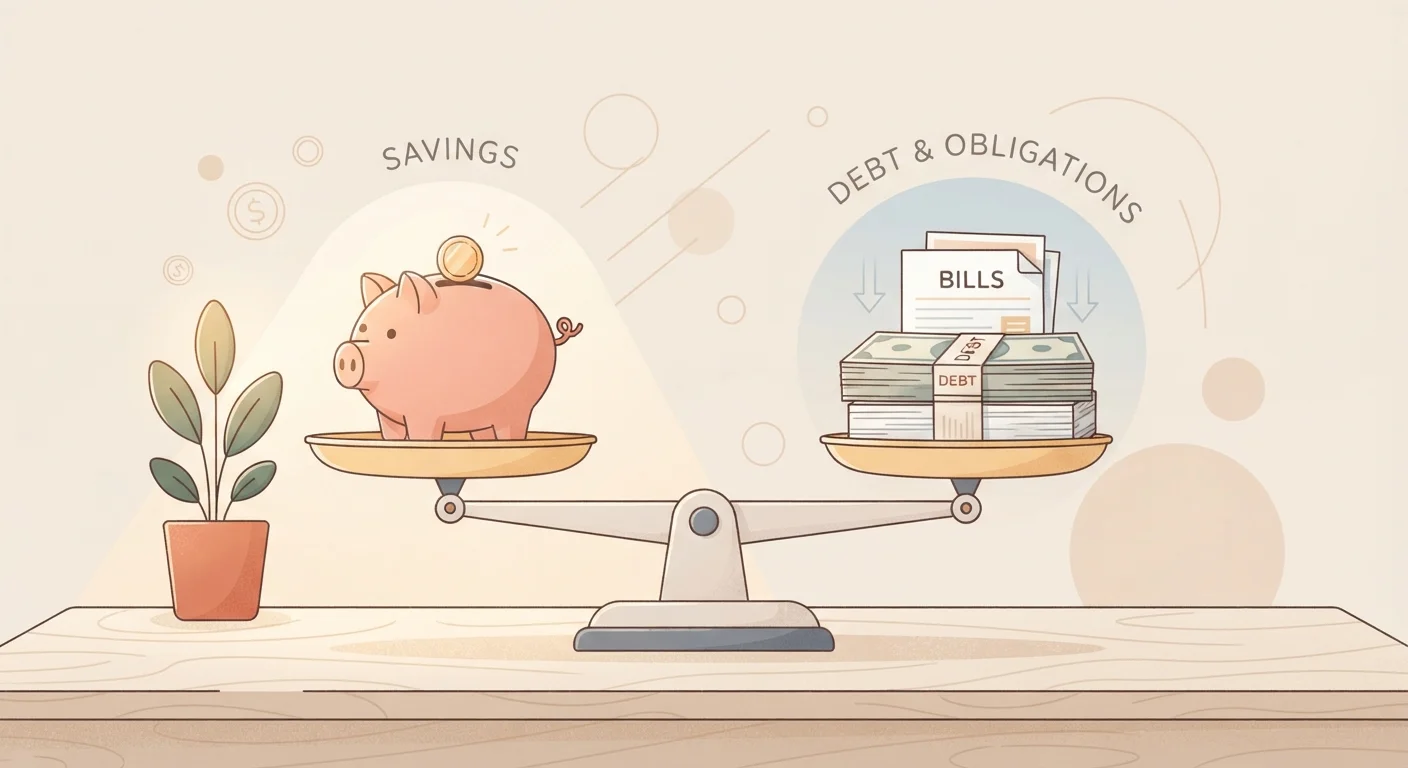

Why Saving and Debt Management Go Hand in Hand
Most personal finance advice treats saving and debt repayment as separate problems. In practice, they are deeply connected. Carrying high-interest debt while trying to save means every dollar is being pulled in two directions at once. Understanding how the two interact is the starting point for making real progress.
Debt reduces your net worth - the difference between what you own and what you owe. Savings build it. That tension is why so many households feel stuck: income arrives, expenses and minimums absorb it, and nothing is left to move forward. Breaking that pattern requires a deliberate sequence, not just effort.
For a grounding look at how money flows in a household before you tackle saving or debt, our end-to-end budgeting guide walks through setting up a plan that accounts for real-life variability. Budgeting is the infrastructure that makes both saving and debt repayment possible.
77%
Americans carrying some form of debt
According to Bankrate's annual financial security survey, the vast majority of U.S. adults hold at least one form of debt, from credit cards to mortgages.
$6,000+
Median credit card balance per U.S. household
Federal Reserve data consistently shows thousands of dollars in revolving credit card debt carried month-to-month by American households.
~40%
Adults unable to cover a $400 emergency without borrowing
The Federal Reserve's Report on the Economic Well-Being of U.S. Households has repeatedly found that a large share of adults lack a basic cash buffer.
Building Your Financial Foundation: The Emergency Fund
Before accelerating debt payments, most financial educators recommend holding a small emergency fund - commonly cited at $1,000 to one month of essential expenses. The reason is straightforward: without a cash buffer, an unexpected car repair or medical bill sends you straight back to borrowing, undoing your progress.
Once high-interest debt is cleared, expanding that buffer to three to six months of living expenses becomes the next savings priority. This range is a general guideline; the right amount depends on your income stability, number of dependents, and risk tolerance.
Start Small and Specific
If saving feels impossible right now, start with a fixed dollar amount each pay period - even $25 - directed to a separate account. Naming the account after its purpose ("Emergency Fund") has been shown in behavioral research to increase follow-through. The habit matters more than the initial amount.
The question of whether to prioritize the emergency fund or debt paydown first is genuinely nuanced. Our article Emergency Fund vs. Paying Off Debt walks through the trade-offs so you can decide what fits your situation.
Understanding Your Debt: Types, Costs, and Priorities
Not all debt is equal. The single most important factor in prioritizing repayment is the interest rate - specifically the APR, which reflects the true annual cost of borrowing including fees. Credit card debt commonly carries double-digit APRs, meaning balances compound quickly if only minimums are paid.
Debt broadly falls into two categories:
- High-interest, unsecured debt - credit cards, personal loans, payday loans. These carry the highest cost and no collateral backing them.
- Lower-interest, secured or structured debt - mortgages, federal student loans, auto loans. These often carry lower rates and may have tax considerations or income-based repayment options.
If the language on your statements feels confusing - compound interest, balance transfers, minimum payment traps - our plain-language debt glossary defines the key terms clearly.
Payday Loans Carry Extreme Risk
Payday loans and similar short-term, high-fee products can carry effective APRs in the triple digits. They are designed to be repaid within days but frequently trap borrowers in repeat cycles of borrowing. If you are considering one, exhaust all alternatives first - including negotiating a payment plan with the creditor directly or contacting a nonprofit credit counseling agency.
Proven Strategies for Paying Down Debt
Two well-known frameworks dominate debt repayment strategy:
- Debt Avalanche: Direct extra payments to the highest-APR balance first, regardless of size. Mathematically, this minimizes total interest paid over time.
- Debt Snowball: Pay off the smallest balance first for a psychological win, then roll that payment toward the next. Research suggests this approach can improve follow-through for some people, even though it costs slightly more in interest.
Neither method is universally superior. The right one is whichever you will actually stick to. Many people use a hybrid - clearing one or two small balances for momentum, then switching to avalanche for the larger, costlier accounts.
Before choosing avalanche or snowball, check whether any of your accounts offer a 0% promotional APR on balance transfers. Moving high-rate balances there - with a clear payoff plan - can reduce interest costs during the promotional window.
Balance transfer offers can effectively pause interest accrual, letting more of each payment reach the principal. However, transfer fees and rate resets at the end of the period must be factored into the decision.
Call your credit card issuer and ask for a lower interest rate - especially if you have a history of on-time payments. This one conversation costs nothing and occasionally works.
Issuers have discretion to adjust rates for customers in good standing. A lower APR means more of every payment reduces principal rather than covering interest charges.
Emotional barriers are a real and underappreciated obstacle. Shame and avoidance frequently cause people to delay opening statements or seeking help. Our article on the psychology of debt explores how to recognize these patterns and work around them practically.
Growing Your Savings Beyond the Emergency Fund
Once high-cost debt is under control and your emergency fund is in place, savings can be directed toward longer-range goals: a down payment, education costs, retirement contributions, or simply building financial resilience. The mechanics matter less than the habit of consistent contribution.
Automation is one of the most reliable tools available. Setting up automatic transfers on payday - before discretionary spending has a chance to absorb the funds - removes the daily decision and builds savings passively. Our guide to automating your savings explains how to structure these transfers effectively, including round-up tools and pay-yourself-first approaches.
As your savings grow, tracking your net worth provides the clearest picture of overall financial health. It captures both the growth in assets and the reduction in liabilities in one number. See Tracking Net Worth: What It Is, Why It Matters, and How to Start for a straightforward introduction.
Putting It All Together: A Practical Action Plan
The sequence below reflects broadly accepted personal finance guidance, though individual circumstances vary. Treat it as a starting framework, not a rigid prescription:
- Know your numbers. List every debt with its balance, APR, and minimum payment. Then calculate monthly take-home income and fixed expenses.
- Build a starter emergency fund. Aim for $1,000 or one month of essential expenses before accelerating debt payments.
- Attack high-interest debt. Choose avalanche or snowball and direct every extra dollar there consistently.
- Expand your emergency fund. Once costly debt is cleared, grow the cushion to three to six months of expenses.
- Automate and redirect. Set up automatic savings contributions and begin directing funds toward medium- and long-term goals.
- Review regularly. Life changes - income, expenses, and goals shift. Revisit your plan at least twice a year.
If you share finances with a partner or housemate, aligning on priorities and contribution splits is essential. Our article on managing money as a household covers practical structures for joint financial decisions.
“The secret to getting ahead is getting started. The secret to getting started is breaking your complex, overwhelming tasks into small, manageable tasks, and then starting on the first one.”
— Mark Twain, American author and essayist, widely cited on the psychology of starting difficult tasks
This article is for general informational and educational purposes only and does not constitute personalized financial, investment, tax, or legal advice. Consult a qualified financial professional for guidance specific to your situation.