Why Go Carry-On Only?
Ditching checked luggage is one of the most liberating upgrades a traveler can make. The benefits compound quickly: no baggage fees (which can run $35-$75 per bag each way on many U.S. carriers), no waiting at the carousel after a long flight, and zero risk of an airline losing or delaying your belongings. You step off the plane and go - directly to your hotel, your train, your adventure.
Carry-on-only travel also encourages sharper planning. When everything you bring must fit in one bag, you naturally prioritize, which leads to lighter physical and mental loads. It's especially practical for weekend getaways, two-week European trips, and first-time solo travelers navigating unfamiliar transit systems alone.
$75+
Average checked bag fee per leg on some U.S. carriers
Baggage fee structures vary by airline and fare class; fees have risen steadily over the past decade according to industry reports.
30 min
Average baggage carousel wait time saved
Travelers who skip checked luggage commonly report saving 20-40 minutes per arrival, particularly at busy hub airports.
26 lbs
Common international carry-on weight cap
Many non-U.S. carriers enforce carry-on weight limits that differ significantly from domestic U.S. airline policies.
Understanding Airline Size and Weight Rules
This is where carry-on travel requires real homework. There is no universal standard. U.S. major carriers generally allow a carry-on up to roughly 22 x 14 x 9 inches, but budget airlines - both domestic and international - often impose stricter limits and may charge fees for bags that exceed them. Some low-cost European and Asian carriers allow carry-ons as small as 18 x 14 x 8 inches.
Weight limits add another layer. While many U.S. airlines don't enforce a carry-on weight cap, international carriers frequently set limits between 15 and 26 lbs. Always check the specific policy for every airline on a multi-leg itinerary - the most restrictive leg sets your practical limit.
Budget Airlines Play by Different Rules
Low-cost carriers - including many popular options for intra-Europe, Central America, and Southeast Asia routes - may count a standard carry-on as a paid upgrade and restrict free carriage to a small personal item only. Review the full fare conditions of every ticket before purchase. The savings on the base fare can evaporate quickly if you're hit with unexpected bag fees at the gate.
Before finalizing your travel itinerary, confirm carry-on policies directly on each airline's official website. Policies can change and third-party summaries may be outdated.
Choosing the Right Bag
Your bag choice shapes everything. The three main options are hardshell spinner suitcases, soft-sided rolling bags, and backpack-style travel packs. Each has trade-offs.
- Hardshell spinners protect fragile items well but take up fixed volume and may not compress into tighter overhead bins.
- Soft-sided rollers flex slightly to fit snug spaces and often weigh less than hardshells, maximizing your weight budget for actual belongings.
- Travel backpacks (40-45 liters) go under the seat in front of you on most aircraft, making them ideal when overhead bins are full - and they're essential for travelers moving through cities on foot or navigating stairs-heavy transit.
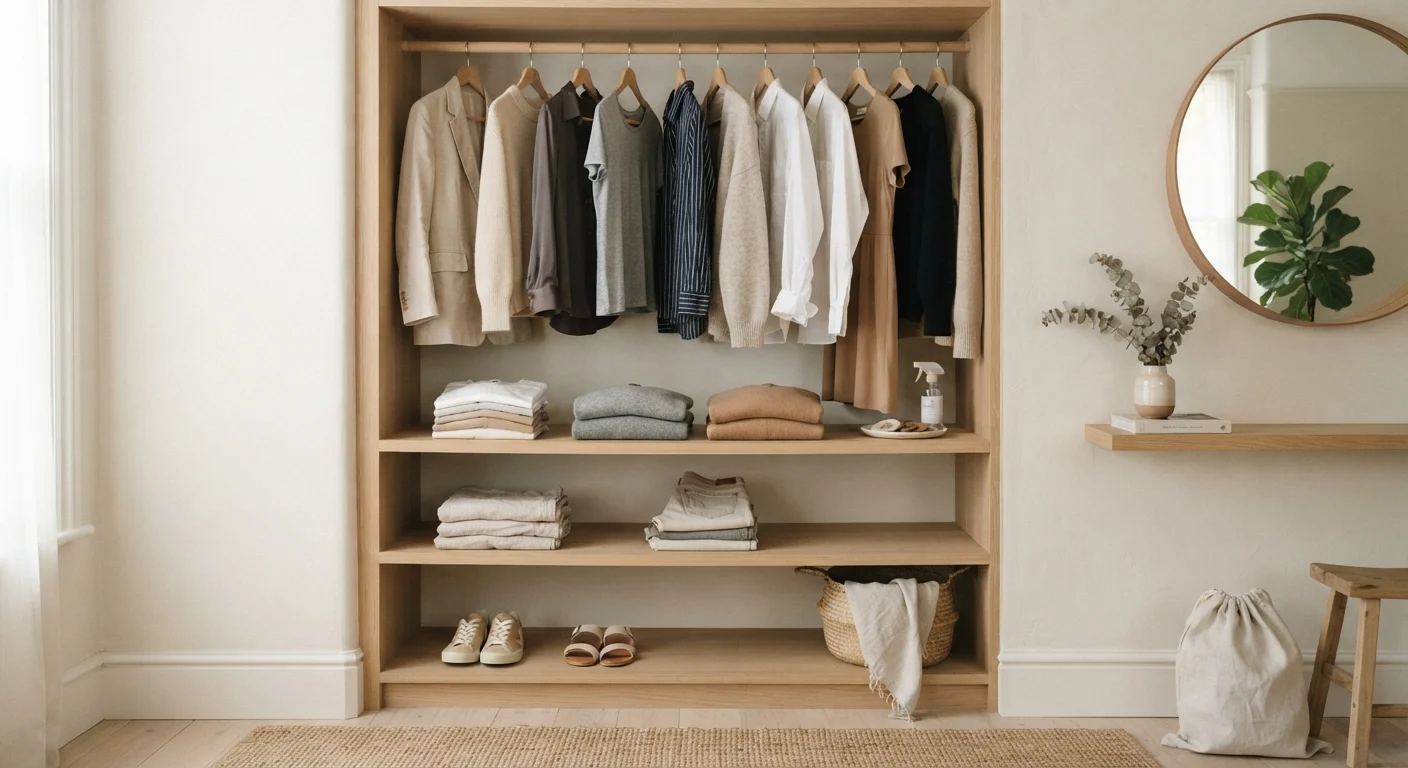
Look for bags with a dedicated laptop sleeve, external water bottle pocket, and compression straps. The principles behind a capsule wardrobe apply here too: fewer, better-chosen items outperform a cluttered collection every time.
Wear your heaviest items - boots, a jacket, or a chunky sweater - on travel days instead of packing them. This trick alone can save two to three pounds of bag weight.
Weight worn on your body doesn't count toward your carry-on allowance, and it's one of the most consistent space-saving strategies used by frequent light travelers.
Place a small, inexpensive luggage scale in your toiletry kit so it's always with you. Weigh your bag before every departure to avoid surprise gate fees.
Airline weight enforcement varies by route and carrier, but being caught over the limit at an international gate can result in fees equal to or exceeding a checked bag charge.
The Art of Packing Light
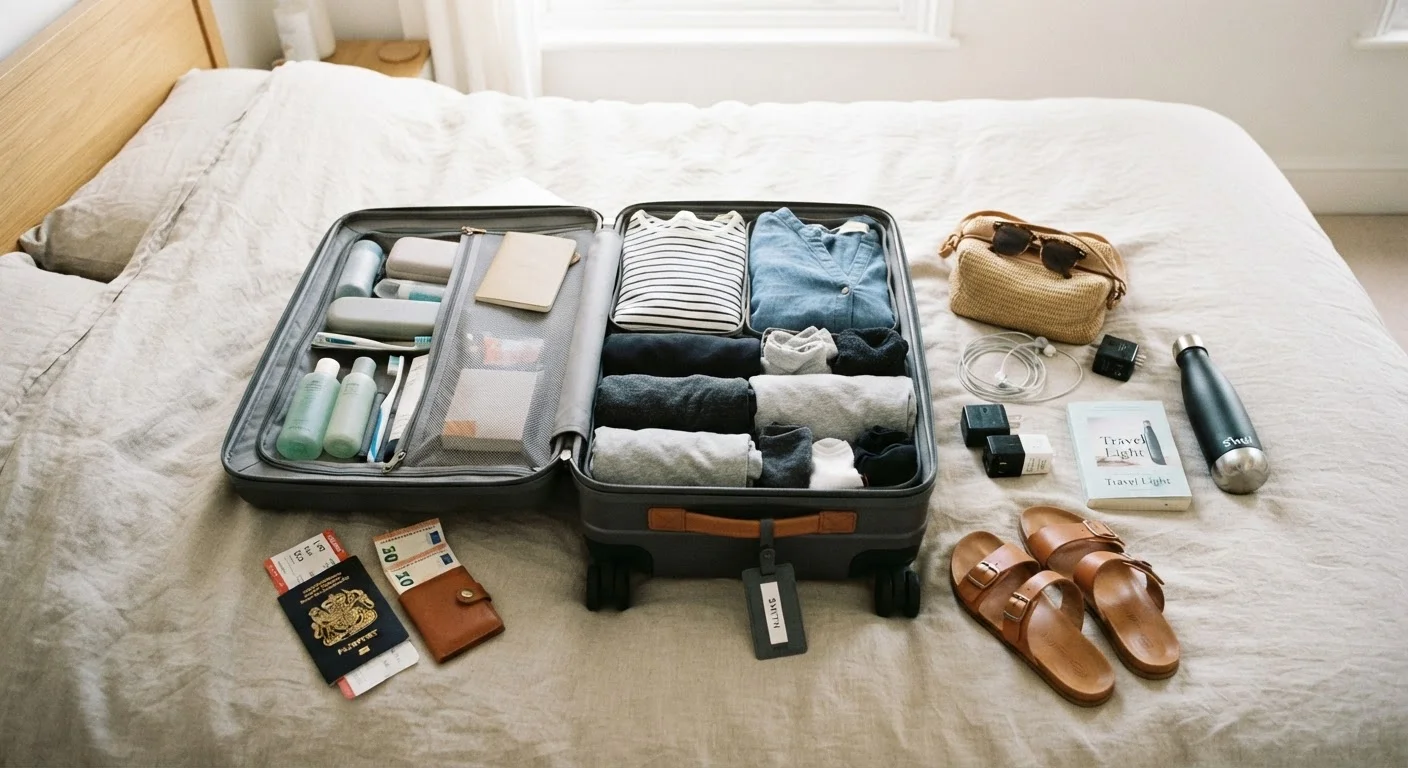
Efficient packing is a learnable skill, not a talent. Start with a clothing framework built around a neutral color palette - navy, grey, black, white, and one accent color - so every piece mixes and matches. A practical carry-on wardrobe for a 7-10 day trip typically includes:
- 3-4 tops (mix of casual and one slightly elevated option)
- 2 bottoms (one can double as evening wear)
- 1 lightweight layer (a packable jacket or merino cardigan)
- 3-4 pairs of underwear and socks (merino wool dries fast and resists odor)
- 1 pair of versatile shoes worn on the plane, plus compact sandals or flats in the bag
Rolling clothes rather than folding them reduces wrinkles and saves roughly 20-30% more space. Packing cubes help you stay organized and compress softer items further. For destinations with challenging weather, see our guide on packing for extreme climates without overstuffing your bag.
The "One Out, One In" Packing Rule
Before adding any item to your bag, ask: "Does this replace something already in here?" If the answer is no, reconsider. This single mental check prevents the gradual accumulation that turns a light pack into an overstuffed one. Experienced carry-on travelers often lay out everything they plan to bring, then remove one-third before zipping up.
Toiletries, Liquids, and the TSA 3-1-1 Rule
The Transportation Security Administration's 3-1-1 rule governs liquids in carry-on bags for U.S. domestic and many international departures: each liquid, gel, or aerosol must be in a container of 3.4 oz (100 ml) or less, all containers must fit in one quart-sized clear zip-top bag, and each passenger is limited to one such bag. This applies to shampoo, conditioner, sunscreen, toothpaste, and even peanut butter.
Solid alternatives - shampoo bars, solid conditioner, toothpaste tablets, and stick sunscreen - sidestep the liquid rule entirely and are widely available. Many travelers also buy toiletries at their destination, particularly for longer trips, which frees up bag space and eliminates airport security friction.
TSA Rules Apply to U.S. Departures
The 3-1-1 liquids rule is a U.S. Transportation Security Administration policy. Other countries have adopted similar rules under ICAO guidance, but exact limits and enforcement vary. Always check the security requirements of your departure country, not just your destination, before you pack your toiletry bag.
Staying Connected and Safe On the Road
Traveling light doesn't mean traveling unprepared. For tech, a phone, a compact universal adapter, a portable battery, and earbuds cover most traveler needs without adding significant weight. Download offline maps, your airline app, and any tickets before departure.
Digital safety matters as much as physical safety. Public Wi-Fi in airports, hotels, and cafés can expose your devices to interception. See our guide to staying safe online while traveling for practical steps to protect your data. And before you leave home, work through the pre-departure safety checklist to make sure documents, emergency contacts, and health prep are all in order.
Never Pack Medications in Your Carry-On Overhead Bin
Keep all prescription and essential medications in your personal item - the bag that stays under the seat in front of you - not in the overhead bin. On some small aircraft, carry-ons are gate-checked and may be inaccessible mid-flight. Always carry enough medication for several extra days in case of travel delays, and keep prescriptions in their original labeled containers when crossing international borders.
Common Carry-On Mistakes to Avoid
Even experienced light travelers fall into predictable traps. Watch for these:
- Packing for hypotheticals. That formal outfit "just in case" almost never gets worn. Pack for the trip you're actually taking.
- Ignoring gate-check policies. On small regional aircraft, overhead bins are limited and bags are frequently gate-checked - sometimes unexpectedly. Keep valuables and medications in a personal item that stays with you.
- Forgetting the personal item allowance. Most airlines permit one carry-on plus one personal item (a small backpack, tote, or laptop bag). Using both allocations strategically gives you meaningful extra capacity.
- Overpacking "just in case" toiletries. Mini versions of most toiletries are available globally. Buying locally when you run out is far simpler than overfilling your liquids bag.
- Not weighing the bag at home. A simple luggage scale prevents an embarrassing - and expensive - moment at the check-in counter or gate.
The more you travel carry-on only, the more intuitive the editing process becomes. Most dedicated light travelers report that after two or three carry-on trips, they return home with items they never used - proof that packing less is almost always the right call.