
Why Budgeting Vocabulary Matters
Budget templates, financial apps, and money advice articles all use a shared vocabulary. When you recognize terms like net income or discretionary spending on sight, you spend less energy decoding language and more energy actually managing your money. This reference covers the core terms you'll encounter when building or reviewing any personal budget - with plain definitions you can apply immediately.
This article is general financial education and is not personalized financial advice. For guidance specific to your situation, consult a qualified financial professional.
Gross Income
Total earnings before any taxes or deductions are removed. This is the number on your offer letter or contract, not what actually hits your bank account.
Net Income
Take-home pay after taxes, Social Security, Medicare, and pre-tax deductions are withheld. This is the correct figure to use as the foundation of any personal budget.
Fixed Expense
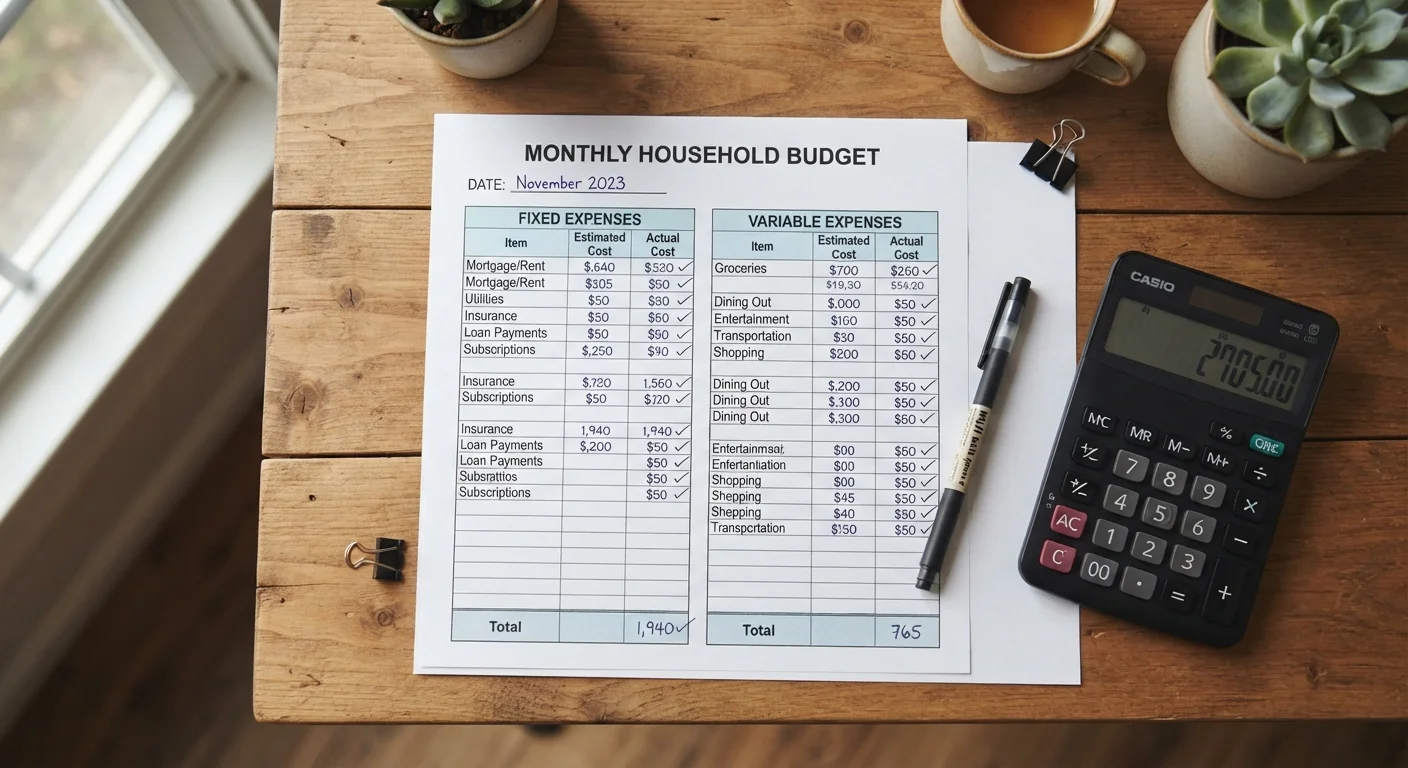
A recurring cost that remains the same amount each period, such as rent or a loan payment. Fixed expenses are predictable and easy to plan for.
Variable Expense
A recurring cost whose amount changes from month to month, such as groceries or gasoline. Variable expenses require closer monitoring and estimated averages when budgeting.
Discretionary Spending
Money spent on wants rather than needs - dining out, entertainment, subscriptions, and similar non-essential purchases. This category typically offers the most flexibility for adjustments.
Non-Discretionary Spending
Spending on necessities that are difficult or unwise to cut: housing, utilities, food, transportation to work, and required minimum debt payments.
Periodic Expense
A predictable but infrequent cost - such as annual insurance renewals, car registration, or holiday spending - that does not appear in every monthly budget cycle.
Emergency Fund
A dedicated savings reserve held in a liquid account to cover unexpected financial shocks without borrowing. It acts as a financial buffer between you and high-interest debt.
Debt-to-Income Ratio (DTI)
Your total monthly debt payments divided by your gross monthly income, expressed as a percentage. It is used by lenders to gauge repayment capacity and is a useful self-assessment tool.
Zero-Based Budget
A budgeting method in which every dollar of income is assigned a purpose - spending, saving, or debt repayment - so that income minus all allocations equals zero at the end of the month.
Pay Yourself First
A savings philosophy in which a predetermined savings amount is set aside immediately when income arrives, before any discretionary spending decisions are made.
Budget Surplus / Deficit
A surplus occurs when income exceeds total expenses; a deficit occurs when spending exceeds income. Tracking these monthly reveals trends and guides corrective action.
Income Terms: What's Coming In
Getting income terminology straight is the essential first step, because every budget calculation flows from it.
| Starting point for budgeting | Net (take-home) income |
| Fixed expense example | Monthly rent or mortgage payment |
| Variable expense example | Monthly grocery or gas spending |
| Common emergency fund target | 3-6 months of essential expenses (General financial education guideline; individual needs vary) |
| DTI formula | Monthly debt payments ÷ gross monthly income |
| Zero-based budget goal | Income minus all allocations = $0 |
Gross income is the total amount you earn before any taxes or deductions are removed. Your paycheck stub will usually show this at the top. Net income - often called take-home pay - is what remains after federal and state taxes, Social Security, Medicare, and any pre-tax benefit deductions like health insurance or a 401(k) contribution are withheld. Always build your budget from net income, not gross. Overestimating available money is one of the most common reasons budgets collapse in the first month.
If you have multiple income streams - a side gig, rental income, or freelance work - list each separately and be conservative when estimating irregular sources. For a deeper look at structuring these numbers into a usable plan, see Your First Budget: A Ground-Up Guide for Complete Beginners.
Expense Terms: What's Going Out
Expenses fall into a few distinct categories, and knowing which is which shapes every budgeting decision you make.
Fixed expenses stay the same amount each billing cycle - rent, a car loan payment, or a fixed-rate insurance premium. Variable expenses shift month to month - groceries, gas, and utility bills are typical examples. For a more thorough breakdown of how these two expense types behave differently in a budget, the article Fixed vs. Variable Expenses is a useful companion read.
Discretionary spending refers to non-essential purchases - dining out, streaming services, hobbies, clothing beyond basics. These are the categories where you typically have the most control. Non-discretionary spending covers necessities: housing, utilities, food, healthcare, and minimum debt payments. Finally, periodic expenses are costs that don't hit every month - car registration, annual subscriptions, holiday gifts - but are entirely predictable. Experienced budgeters set aside a small amount each month for these so they don't arrive as surprises.
Don't Overlook Periodic Expenses
Many first-time budgeters balance their numbers based on a single month, then feel blindsided when a car registration or annual subscription hits. A practical workaround: add up all your known periodic expenses for the year, divide by 12, and include that monthly average as a dedicated line item. When the bill arrives, the money is already set aside.
Savings and Debt Terms You'll See Often
A functional budget does more than track spending - it allocates money toward financial goals and debt reduction.
An emergency fund is a dedicated reserve of liquid savings (typically kept in a savings or money market account) meant to cover unexpected expenses or income disruption without forcing you into debt. Financial educators commonly suggest aiming for three to six months of essential expenses, though the right amount depends on individual circumstances.
Debt-to-income ratio (DTI) is a percentage calculated by dividing your total monthly debt payments by your gross monthly income. Lenders use this figure to assess creditworthiness; a lower DTI generally signals stronger financial health. Minimum payment is the smallest amount a creditor requires you to pay each billing cycle to keep an account current. Paying only the minimum on high-interest debt extends repayment timelines significantly and increases total interest paid - a concept explored further in High-Interest Debt: A Plain-Language Glossary.
Pay yourself first is a savings philosophy where a set amount is directed to savings or investments before any other spending decisions are made - treating savings as a non-negotiable line item rather than whatever is left over. You can see how this fits alongside other approaches in Budgeting Approaches Compared.
For broader definitions of everyday financial terms beyond budgeting, Financial Terms You Encounter Every Month - Defined Simply provides a useful complement to this glossary. And if you're ready to put these concepts to work, Your First Budget: Building a Spending Plan That Doesn't Feel Like a Diet walks through the process step by step.