
Why 'Later' Almost Never Comes
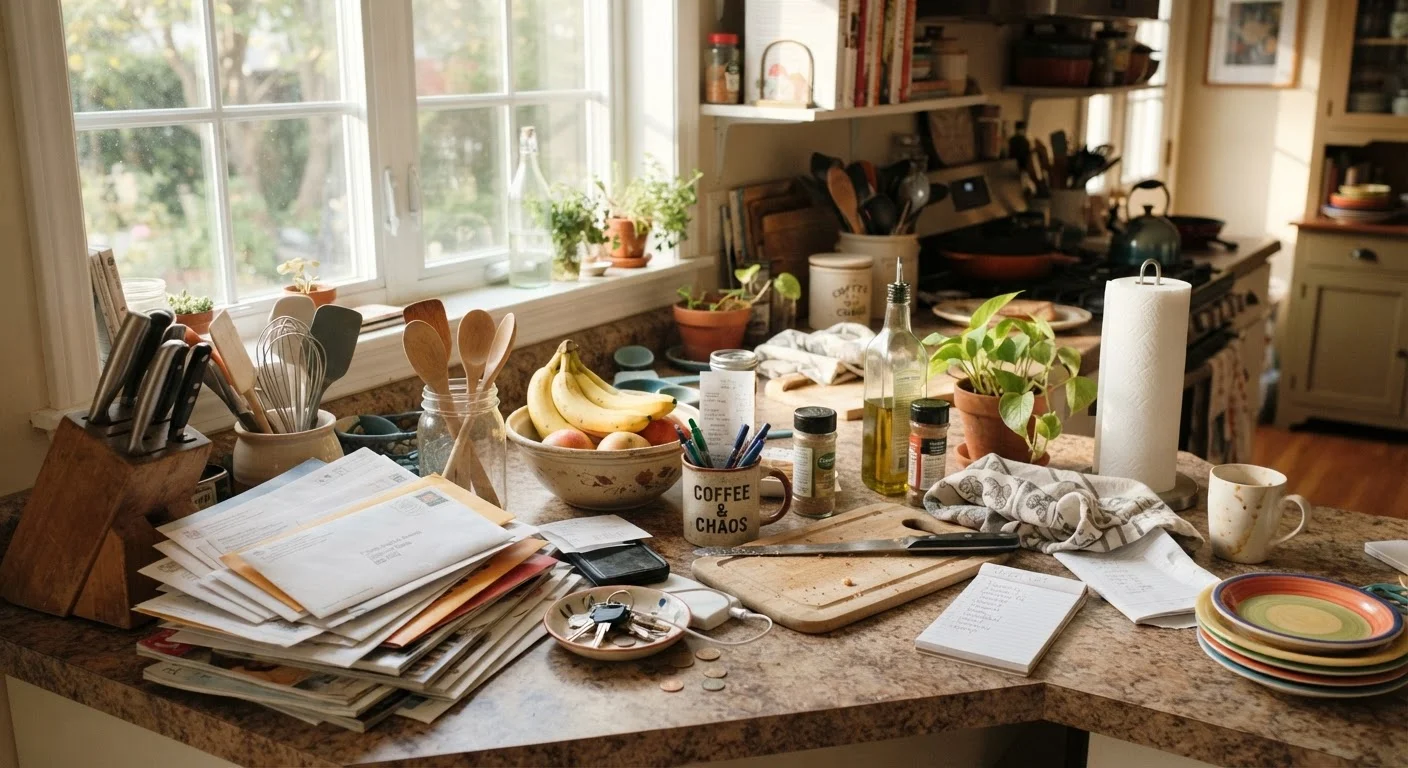
The phrase 'I'll organize it later' feels reasonable in the moment - you're busy, the pile isn't urgent, and there's always tomorrow. But 'later' is a moving target, and in the meantime, items keep accumulating. What started as a small stack of mail becomes a counter buried under months of decisions that were never made.
This isn't a character flaw. It's a predictable pattern driven by decision fatigue, an all-or-nothing mindset, and the absence of systems that make tidying automatic. Understanding why the delay happens is the first step toward interrupting it. For a broader look at how this pattern shows up in other areas of daily life, why good habits collapse explores the same mechanisms in a different context.
Clutter Has a Compounding Effect
Each item left without a home makes it easier to leave the next one. Over time, visual clutter raises background stress levels and makes the task feel too large to start. Addressing small accumulations early is almost always faster and less taxing than tackling a backlog - even when it doesn't feel urgent in the moment.
The Mistakes That Keep the Clutter Coming Back
Most disorganized spaces aren't the result of one bad day - they're the accumulated product of small, repeated missteps. The mistakes below are extremely common, and more importantly, each one has a practical fix that doesn't require a full weekend or a complete personality overhaul.
Treating organizing as a single large event rather than an ongoing habit.
Why it happens: We tend to imagine a future weekend with unlimited time and energy - a clean-slate moment that rarely arrives on schedule.
Having no defined 'home' for frequently used items.
Why it happens: When an object doesn't have a designated spot, it lands wherever it's convenient - which is always somewhere temporary.
Waiting until you feel motivated to start organizing.
Why it happens: Motivation follows action more reliably than it precedes it, but most people wait for the feeling to arrive before beginning.
Applying an all-or-nothing standard - if you can't do it perfectly, you don't do it at all.
Why it happens: A common but mistaken belief is that organizing only counts if the entire area is addressed at once. Partial progress feels like failure.
Keeping items 'just in case' without a realistic assessment of actual use.
Why it happens: Loss aversion - the discomfort of potentially needing something you've let go - makes it feel safer to hold onto nearly everything.
If some of these patterns sound familiar, you're not alone. Common myths about organizing - like needing the perfect products before you start - can make these mistakes harder to recognize and easier to repeat.
Building the Habits That Actually Stick
The goal isn't a perfectly organized home that stays frozen in time - it's a set of small habits that keep things manageable without requiring heroic effort. The most effective approach is to make tidying nearly automatic.
Avoid Buying Storage Before You Sort
Purchasing bins, baskets, or shelving units before deciding what you're keeping is one of the most common organizing missteps. You'll likely buy the wrong sizes or quantities - and the new containers can actually give clutter more places to hide. Sort and reduce first; shop for storage second.
Start by identifying your two or three highest-clutter zones and assigning clear homes to everything in them. Then build a short daily reset - five to ten minutes at the same time each day - to return items to those homes. Over a few weeks, this becomes less of a chore and more of a default behavior.
40%
Of household items never used
Research from organizational behavior studies suggests that roughly 40% of items in a typical home go unused for a year or more, yet are kept 'just in case.'
2 min
Threshold for immediate action
Productivity researchers widely cite the two-minute rule: if a task takes less than two minutes, doing it immediately prevents it from becoming part of a growing backlog.
Once you've broken the 'later' cycle, the next challenge is keeping it from creeping back. Long-term tidiness habits, including the one-in, one-out rule, are designed to prevent the backlog from rebuilding. And if you're still figuring out where to begin, getting started with home organization offers a plain-language foundation to build from.