Why the Hands-Free Debate Still Matters
Most US states have enacted laws restricting or banning handheld phone use while driving, pushing many drivers toward Bluetooth earpieces, speakerphone, and integrated vehicle systems. The assumption embedded in those laws - that removing your hands from the device removes the danger - has been repeatedly scrutinized by traffic safety researchers. The picture that emerges is more nuanced than most drivers realize.
Distraction behind the wheel comes in three distinct forms: visual (eyes off the road), manual (hands off the wheel), and cognitive (mind off the task of driving). Hands-free technology effectively addresses the first two. The third is where the controversy lives.
The Genuine Advantages of Hands-Free Calling
There are real, meaningful reasons why hands-free systems represent an improvement over handheld phone use - and dismissing them entirely does drivers a disservice.
Keeps both hands on the steering wheel
Unlike handheld calls, hands-free systems allow continuous two-handed control of the vehicle, which is critical during sudden steering inputs or emergency maneuvers.
Eyes remain forward and on the road
Drivers do not need to look at or pick up a device, preserving visual attention during the call - the most direct form of distraction in handheld use.
Legal compliance in most US states
Hands-free calling satisfies distracted-driving laws in the majority of states, reducing the legal and financial risk of citations that come with handheld phone use.
Allows time-sensitive contact in low-risk moments
For brief, calm, and necessary communications - confirming a pickup time, alerting someone of a delay - a hands-free call on a clear road carries meaningfully lower risk than handheld alternatives.
Integrated systems reduce fumbling and setup distraction
Voice-activated in-car systems allow call initiation without any manual interaction, removing the additional hazard of physically connecting a Bluetooth device while moving.
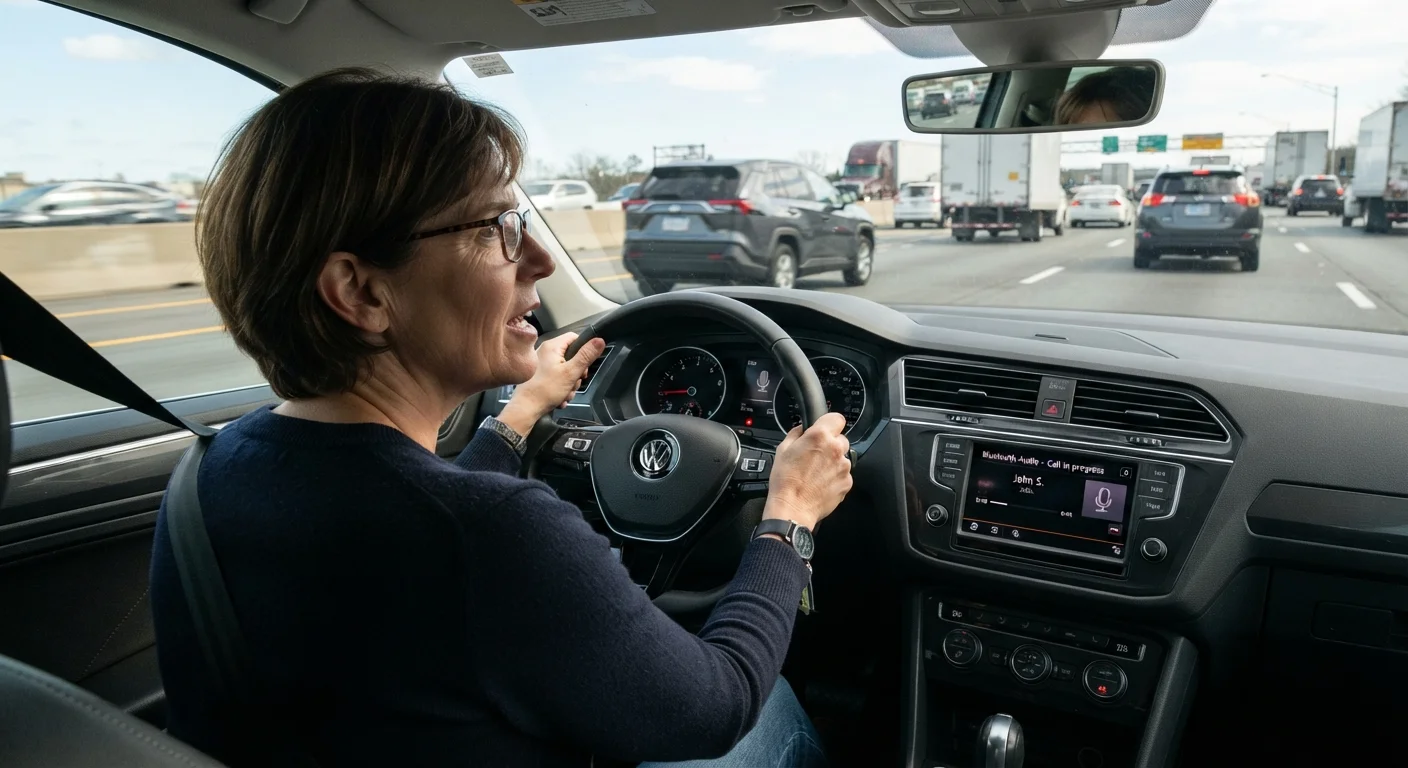
For drivers who need to stay reachable for professional or family reasons, a hands-free setup does allow eyes to stay on the road and both hands to remain on the wheel. In low-complexity driving environments - steady highway cruising with light traffic - the marginal risk of a brief, calm call is considerably lower than scrolling through a phone at a red light.
The Cognitive Cost That Gets Overlooked
The core problem with hands-free use is what researchers call inattention blindness - the phenomenon where a person looks directly at something but fails to process it because cognitive resources are committed elsewhere. Driving simulators and real-world studies have documented that drivers in active phone conversations, even hands-free ones, scan the road less effectively, miss peripheral events, and react more slowly to sudden hazards.
4x
Increased crash risk from phone use while driving
The National Safety Council cites research suggesting drivers using cell phones - handheld or hands-free - are approximately four times more likely to be involved in a crash.
37%
Reduction in brain activity associated with driving
Carnegie Mellon University research using brain imaging found that simply listening to someone speak reduced driving-related brain activity by approximately 37 percent.
This is not simply a matter of being "distracted." The conversation itself - constructing sentences, following narrative threads, managing the emotional register of an exchange - draws on the same mental bandwidth required to anticipate and respond to road conditions. A passenger conversation, by contrast, tends to be self-regulating: passengers naturally pause when traffic demands attention. A caller cannot see what you are navigating and does not modulate accordingly.
Fatigue has a similarly invisible effect on driver attention, degrading reaction time and judgment without the driver always noticing. Cognitive distraction from phone conversations operates through a comparable mechanism.
Cognitive distraction persists regardless of device
Constructing and following a conversation draws on the same mental resources used for hazard detection and decision-making. This impairment occurs whether the phone is held or not.
Inattention blindness reduces hazard detection
Drivers in active phone conversations have been shown in simulation studies to process less of what they are looking at - a driver can be scanning the road but not truly seeing it.
Callers do not self-regulate like passengers do
A passenger naturally pauses when traffic intensifies; a caller has no awareness of road conditions and continues demanding attention at the worst moments.
Emotionally charged calls cause acute attentional narrowing
Stressful, upsetting, or contentious conversations trigger physiological responses that further reduce the cognitive bandwidth available for driving, regardless of call method.
Legality can create a false sense of safety
Because hands-free use is permitted by law, many drivers assume it has been validated as safe - obscuring the real cognitive risk that remains after the manual and visual elements are removed.
Risk compounds in complex driving environments
Heavy traffic, adverse weather, unfamiliar roads, or highway merging all demand higher baseline cognitive load - adding a phone conversation in these conditions multiplies the risk substantially.
What the Law Says vs. What Research Suggests
Legality and safety are not the same standard. In most US states, a hands-free call is fully lawful for adult drivers - yet traffic safety organizations, including the National Safety Council, have publicly stated that hands-free devices do not eliminate crash risk. Several studies have estimated reaction-time impairment from phone conversations as roughly comparable to driving at or near the legal blood alcohol limit of 0.08%, though specific findings vary by study design and should be interpreted with that context in mind.
Legality vs. Safety: An Important Distinction
Traffic laws set a minimum standard of regulated behavior - they are not designed to define the full range of safe driving choices. The National Safety Council has explicitly stated that hands-free devices are not risk-free and has advocated for broader restrictions. Drivers should treat legal compliance as a floor, not a ceiling, when it comes to in-car phone use.
Drivers who understand this gap between legal permission and actual risk are better equipped to set their own, more protective personal standards - particularly in high-demand driving situations like merging, navigating unfamiliar roads, or driving in adverse weather.
Building Smarter Personal Rules
The research does not call for eliminating all hands-free use - it calls for deliberate, situational judgment. A few practical principles are worth internalizing:
- Match call complexity to driving complexity. A quick check-in on a familiar, lightly traveled road is very different from a negotiation call on a congested interstate.
- Emotionally charged conversations should wait. Anger, grief, or anxiety triggered by a call measurably narrows attentional focus. Pull over when a discussion escalates.
- Use call screening and voicemail intentionally. Many urgent-seeming calls can safely wait five or ten minutes without consequence.
- Consider your passengers. On longer journeys, managing fatigue and attention is already an ongoing task - adding phone calls compounds the load.
The goal is not perfection but awareness. Knowing that hands-free does not mean risk-free is the first step toward making choices that genuinely reflect your own safety priorities.