Why Extreme Conditions Demand a Different Mindset
Most drivers develop their habits in ordinary conditions - dry roads, reasonable visibility, calm air. Those habits become deeply ingrained. The problem is that extreme weather doesn't just make driving harder; it fundamentally changes the physics of the road and the margin for error available to you.
Fog removes your ability to read the road ahead. Ice decouples your inputs - steering, braking, accelerating - from reliable outcomes. High winds introduce lateral forces your car wasn't designed to handle at speed. Each hazard requires not just caution, but specific, deliberate technique changes.
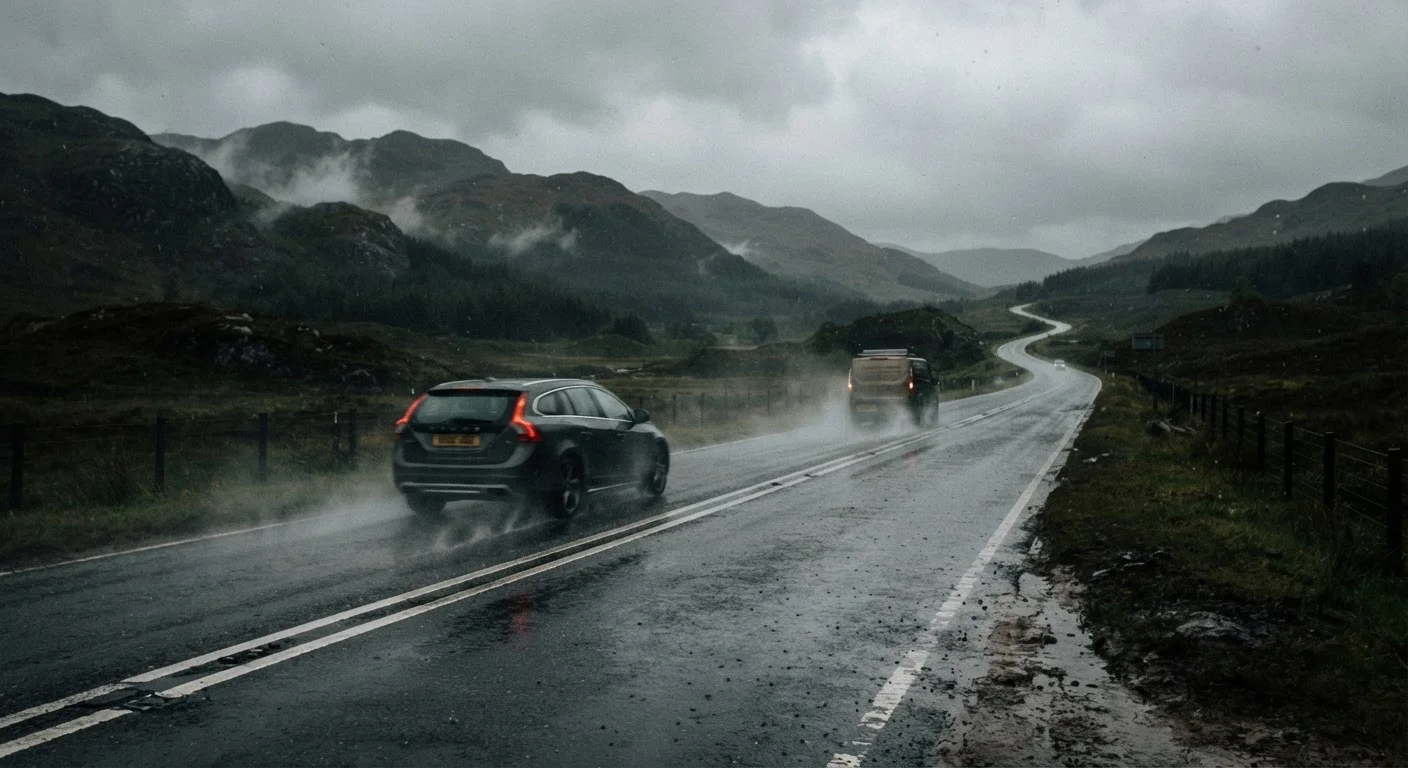
Rain is often the first serious weather challenge drivers face. For a detailed look at how wet roads alter your braking and grip, see our guide on adjusting your driving in rain. The principles covered here build on that foundation and extend into the more extreme end of the spectrum.
8-10×
Longer stopping distance on ice vs. dry road
Widely cited by road safety authorities including the US National Safety Council as a benchmark for ice braking distances.
~100m
Visibility threshold for rear fog light use
The 100-meter (approximately 330 feet) threshold is the standard guideline used across most US and international road safety frameworks.
4 sec+
Recommended following gap in dense fog
Safety authorities recommend at minimum doubling the standard two-second rule in low-visibility conditions; more in severe fog.
Driving in Fog: Visibility, Speed, and Spacing
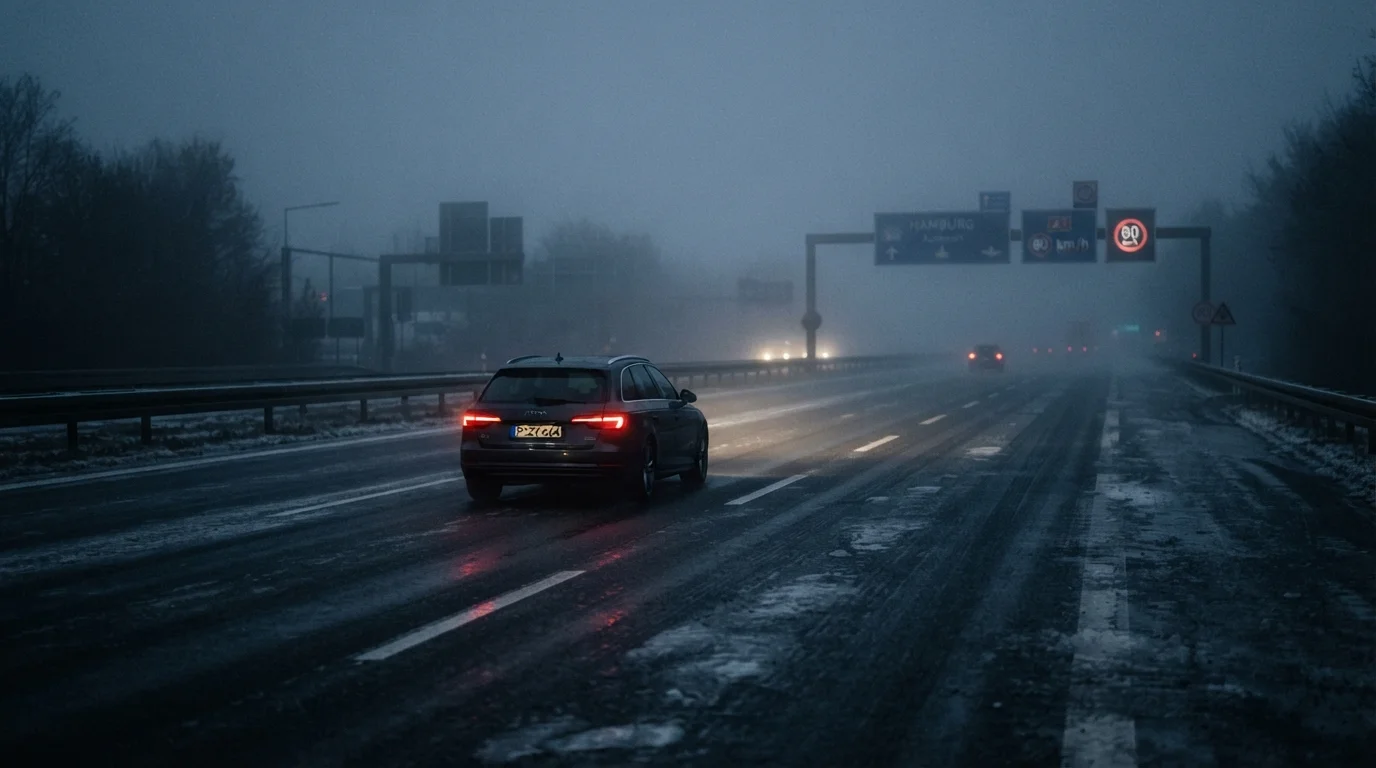
The core rule in fog is simple but hard to internalize: drive at a speed at which you can stop within the distance you can see. If your visibility is 50 feet, your stopping distance must be 50 feet or less - which, for most vehicles on dry pavement, means speeds well under 20 mph. On any degraded surface, that number drops further.
Lights: What to Use and What to Avoid
Use dipped (low-beam) headlights - not full beam. High beams reflect off water droplets in fog and actually reduce your effective visibility. Rear fog lights should be activated when visibility falls below approximately 100 meters (around 330 feet); beyond that threshold, leaving them on can dazzle the driver behind you and obscure your brake lights. Front fog lights, where fitted, supplement low beams in dense conditions.
Following Distance in Fog
The two-second rule used in normal conditions is wholly inadequate in fog. A gap of at least four seconds - ideally more - gives you reaction time when hazards emerge from the murk. Avoid fixating on the taillights of the vehicle ahead; it encourages tailgating and creates a false sense of security about your own speed.
If conditions are severe enough that you need to stop, pull as far off the road as possible, turn off your headlights (which can attract other vehicles toward you), and keep your hazard lights on.
If you're unsure whether your rear fog lights are on, check your dashboard - the indicator light is typically an amber or red icon showing a rear lamp with wavy lines. Most drivers have never tested this in a real-fog situation, so familiarize yourself with your vehicle's controls before you need them.
Fog-related crashes often involve rear-end collisions; correct use of rear fog lights is one of the simplest preventive actions a driver can take.
On icy roads, shift to a higher gear sooner than normal when pulling away - in a manual, starting in second gear reduces wheel spin. In an automatic, use the 'snow' or 'winter' mode if your vehicle has one.
Reducing torque delivery to driven wheels is the most effective way to prevent wheelspin on low-traction surfaces during acceleration.
Ice and Snow: Traction, Control, and Stopping Distance
Ice is the most unforgiving surface a driver can encounter. Stopping distances on black ice - the near-invisible glaze that forms when moisture freezes on pavement - can be eight to ten times longer than on dry roads. That's not a rough estimate; it's a physics reality based on the coefficient of friction between rubber and ice versus rubber and dry asphalt.
Smooth, Deliberate Inputs
Every input - accelerating, braking, steering - should be gradual on ice. Sudden movements break traction. Accelerate gently from a stop. Brake by applying steady, progressive pressure; if your vehicle has ABS (Anti-lock Braking System), apply firm continuous pressure and let the system modulate. Without ABS, threshold braking - pressing to just below the lockup point - is more effective than pumping, though this requires practice.
Managing a Skid
If the rear of your vehicle begins to slide (oversteer), steer gently in the direction of the skid - don't overcorrect. If the front slides (understeer), ease off the accelerator and allow the wheels to regain grip before steering. Both recoveries require calm, measured responses rather than panic inputs.
Black Ice: No Visual Warning
Black ice is transparent and takes on the color of the road surface beneath it, making it nearly impossible to spot until you're on it. Bridges, overpasses, shaded sections, and early-morning roads are high-risk zones. If temperatures are near or below freezing and road surfaces look 'wet,' treat them as potentially iced until proven otherwise.
Hills and Intersections
Momentum is your friend on icy inclines - avoid stopping partway up a hill if possible. On descents, use engine braking (lower gears in a manual; selecting a lower drive mode in an automatic) to reduce reliance on friction brakes. Approach intersections at a speed that allows for a much longer-than-normal stop.
High Winds: Steering, Positioning, and Vulnerable Moments
Wind is the most underestimated of the three hazards. Drivers often recognize fog and ice as serious threats, but treat wind as a nuisance. A sustained crosswind of 50 mph or a gust above 60 mph can push a standard car significantly across a lane - and can make SUVs, minivans, and towing rigs actively dangerous.
Grip the Wheel and Anticipate Gusts
Keep both hands firmly on the wheel, positioned at 9 and 3 (or 8 and 4). Watch for contextual clues that a gust is incoming: gaps between trees or buildings, emerging onto an exposed bridge or overpass, overtaking a large truck. These moments create sudden changes in air pressure and direction. Reduce speed before reaching these points, not during them.
Lateral Positioning
In strong crosswinds from the right, position your vehicle slightly toward the right side of your lane - this gives you lane margin when a gust pushes you left. Adapt this logic for wind direction. Avoid abrupt lane changes; even small steering corrections at highway speed in high wind can cause overcorrection.
Towing and High-Profile Vehicles
Trailers are particularly susceptible to sway in crosswinds. If a trailer begins to sway, do not brake suddenly - this worsens the oscillation. Ease off the throttle gradually and hold a straight course until the sway dampens. For motorway scenarios where speed and wind interact, our guide on motorway driving risk profiles covers how high-speed environments change your margin for error.
“In high-wind conditions, the most dangerous moments are transitions - leaving a sheltered area, emerging from behind a large truck, or cresting an exposed ridge. These are the seconds that demand both anticipation and a firm grip, not reaction after the gust arrives.”
— Cars & Driving Editorial Team, Automotive safety writers and driving condition analysts
Before You Drive: Preparation That Reduces Risk
Preparation before the journey starts is as important as technique during it. In extreme weather, a vehicle that isn't ready amplifies every hazard.
- Tires: Check pressure and tread depth before any winter or severe weather trip. Tread below 4/32" significantly compromises wet and snow grip. Winter (snow) tires, where appropriate, use a rubber compound and tread design optimized for cold temperatures.
- Visibility systems: Ensure all lights work, wiper blades clear the screen effectively, and washer fluid is topped with a freeze-resistant formula appropriate to your region's temperatures.
- Brakes: Any sponginess, pulling, or grinding should be assessed by a qualified mechanic before driving in conditions that demand maximum braking performance.
- Emergency kit: A blanket, ice scraper, jump leads, a torch, and a charged phone are minimum provisions for severe weather journeys.
Clear all snow and ice from every surface of the vehicle - not just the windshield. Snow sliding off the roof onto your own windshield or into the path of drivers behind you is a real hazard and, in many US states, a legal liability.
Check Your State DOT Before Departing
Most US state Departments of Transportation provide real-time road condition maps, weather alerts, and travel advisories through their official websites or apps. Checking these before a severe weather journey takes under two minutes and can tell you whether roads ahead are already closed, treated, or flagged as hazardous.
When Not to Drive: Recognizing the Threshold
The most underrated skill in severe weather driving is knowing when the journey simply shouldn't happen. No destination is worth a preventable crash. The decision calculus is straightforward: weigh the necessity of travel against conditions that have moved beyond manageable risk.
Indicators that conditions have crossed the threshold include: travel advisories or road closures issued by state DOTs or local authorities; zero-visibility fog with no sign of lifting; freezing rain (rather than snow, which at least offers some grip); and wind speeds that have prompted warnings for high-profile vehicles or bridges in your area. Check weather services and state DOT alerts before departing.
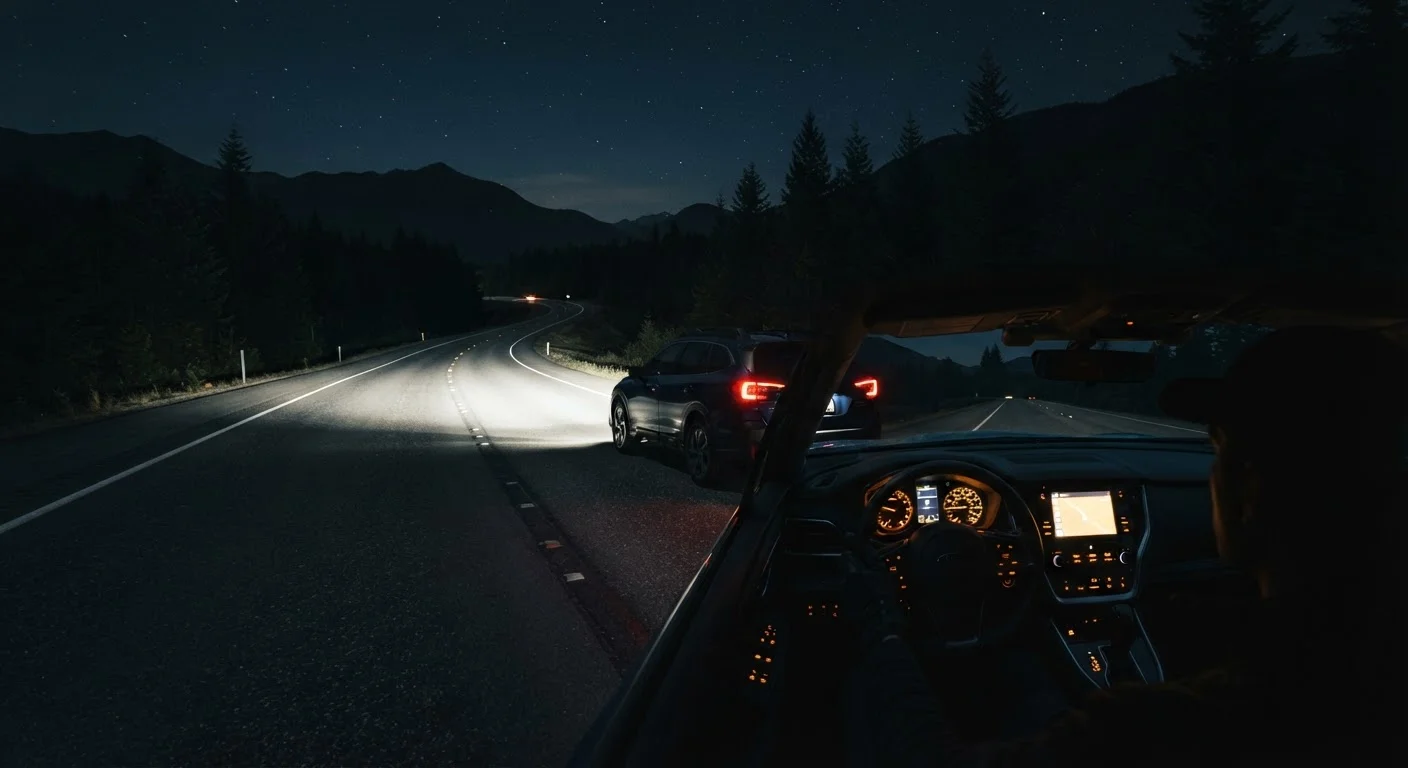
If conditions deteriorate while you are already on the road, don't feel committed to continuing. Finding a safe place to wait - a rest area, a service station, a parking lot - is a legitimate and often correct decision. See how reduced visibility at night compounds these decisions in our guide on night driving habits that reduce risk.
This article is intended as general educational guidance for drivers. It does not constitute legal or professional safety advice. Always comply with local traffic laws and official travel advisories issued by relevant authorities in your area.