The Real Cost of a Missing Service History
Most drivers think of maintenance records as paperwork - an afterthought once the car is running again. In reality, a complete service history is a financial asset that affects your vehicle's resale value, your standing in warranty disputes, and your ability to make accurate claims with your insurer.
When you sell privately or trade in at a dealership, buyers and appraisers will almost always ask about service history. A car with documented, consistent maintenance communicates responsible ownership. One without it carries an implied question mark - and that uncertainty typically translates into a lower offer. For used vehicles, especially higher-mileage ones, a clean service file can meaningfully close the gap with comparable cars that have more favorable odometer readings.
Records also matter long before a sale. If a component fails while still under a manufacturer's warranty, the automaker may ask for proof that required maintenance was performed on schedule. Without that documentation, a legitimate warranty claim can be denied. The same principle applies if you need to demonstrate compliance during an insurance claim involving a mechanical issue.
For a broader view of the financial realities that come with long-term ownership, see our guide to owning an older car.
What Counts as a Maintenance Record?
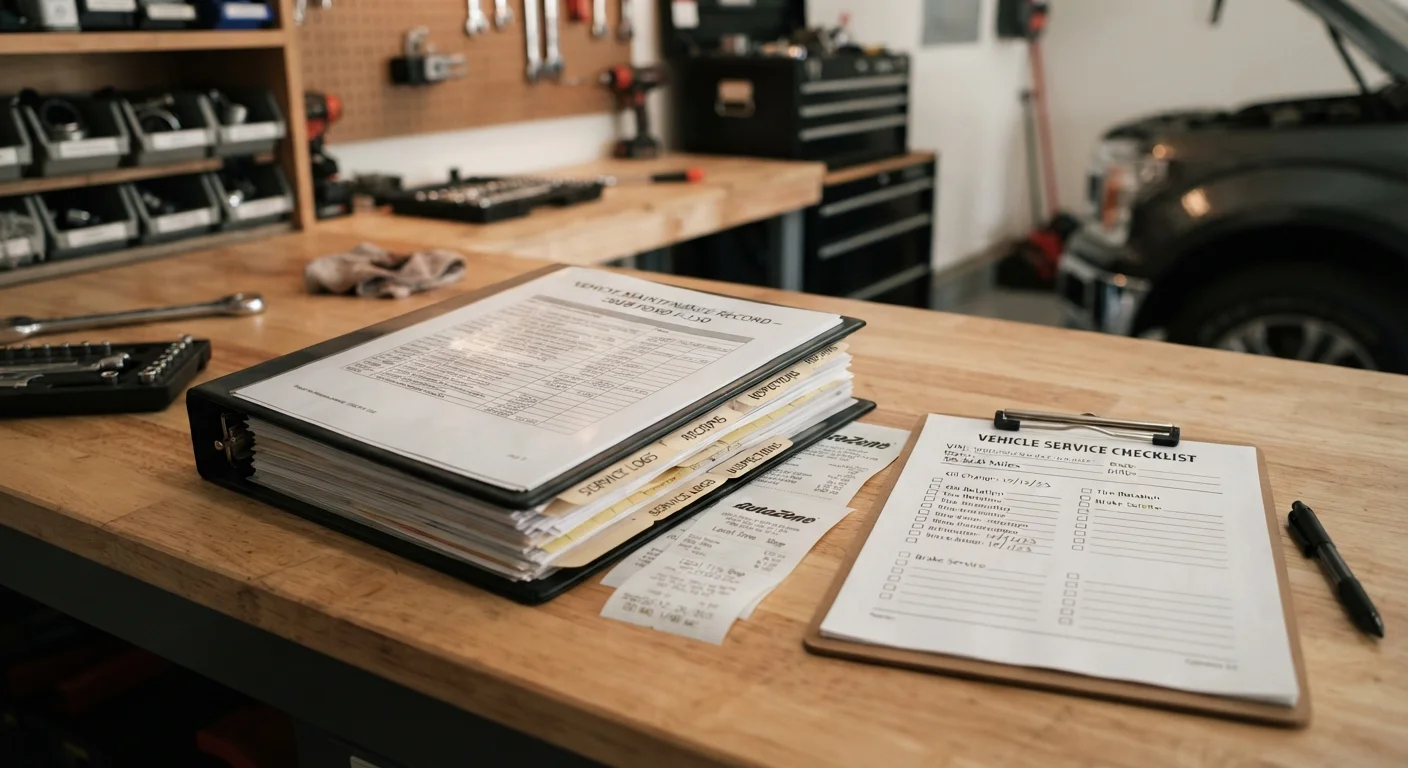
A maintenance record includes any documentation of work performed on your vehicle - oil change receipts, dealer invoices, tire rotation confirmations, alignment printouts, inspection certificates, and even dated notes from DIY work. Recall completion notices from the manufacturer also belong in this file. The broader your paper trail, the stronger your position in any future dispute or sale.
What to Keep and How to Organize It
A useful maintenance file doesn't require an elaborate system - it requires consistency. The goal is to capture every service event: routine or emergency, dealer or independent shop, professional or DIY.
Save every service receipt immediately - even for minor work.
The habit of filing receipts the same day they're issued prevents the gaps that erode a service history's credibility. A single missing oil change interval can raise doubts about an otherwise solid record. Consistent documentation also makes it easier to spot patterns, such as a recurring fluid leak that keeps appearing across separate visits.
Record DIY maintenance with dated, signed notes.
Work you perform yourself won't generate a third-party receipt, but an undocumented change is effectively invisible to a future buyer or mechanic. A written log entry - including the date, mileage, parts used (with brand and part number), and your signature - creates a legitimate paper trail that adds credibility.
Keep both a physical folder and a digital backup of all records.
Paper documents can be lost in floods, fires, or vehicle theft. Digital files can be accidentally deleted or trapped on a defunct phone. Maintaining both formats ensures you always have access when it matters most - such as at a dealership negotiation or during an insurance adjuster's review.
Note the mileage on every record, not just the date.
Service intervals for most vehicles are mileage-based, not calendar-based. A record that shows only a date but no odometer reading is harder to interpret and may be dismissed by a mechanic or buyer trying to verify interval compliance. Mileage gives context that dates alone cannot.
Retain recall completion notices alongside routine service records.
Manufacturers issue safety recalls periodically, and evidence that your vehicle received the required remedy can matter in insurance claims, liability situations, and resale negotiations. These notices are separate from routine maintenance but belong in the same organized file.
Review your records annually and flag overdue items.
A maintenance log is only useful if you actually consult it. An annual review helps you identify services that are approaching their recommended interval and surfaces any gaps in documentation that you can try to reconstruct - for example, by requesting duplicate invoices from a shop.
If you're building your record-keeping habits from scratch, our introduction to car maintenance for new drivers outlines the essential service intervals worth tracking first.
How to Get Started - Even With Gaps
If your service history has gaps, you're not starting from zero - you're starting from wherever you are. Many independent shops and dealerships store customer service records electronically for several years and will provide copies on request. Your credit or debit card statements may also show service-related transactions you can use to reconstruct a rough timeline.
Going forward, the discipline is straightforward: file receipts immediately, note the mileage, back up digitally, and review annually. Drivers who follow a seasonal maintenance calendar naturally create regular documentation touchpoints that build a history over time.
“A vehicle's service history tells the story of how well it was cared for - and buyers, insurers, and mechanics all read that story before they commit to anything.”
— Cars & Driving Editorial Team, Automotive ownership and maintenance specialists
Consistent record-keeping is one of the simplest and most durable habits in vehicle ownership - and one that pays dividends in every scenario where your car's history comes under scrutiny.
For more on the full scope of car maintenance every owner should understand, explore our resource hub.