Why These Two Checks Matter More Than Most Drivers Realize
Tyres are the only part of your vehicle in contact with the road. Their condition directly affects how quickly you can stop, how predictably your car handles, and how much fuel you consume on every trip. Yet surveys consistently show that a large proportion of drivers on US roads are operating with at least one tyre that is significantly under-inflated or has tread approaching the wear limit.
Under-inflated tyres flex more with each rotation, generating excess heat that accelerates internal structural degradation - sometimes invisibly. They also increase rolling resistance, which measurably reduces fuel economy. The US Department of Energy has noted that keeping tyres properly inflated can improve gas mileage, though individual results vary with vehicle type and driving conditions. Worn tread, meanwhile, reduces the tyre's ability to channel water away from the road surface, extending wet-weather stopping distances in ways most drivers wouldn't notice until a panic stop. These aren't edge-case risks; they affect ordinary driving on ordinary roads.
The good news: both checks are quick, inexpensive, and require no mechanical skill. They're also part of a broader habit of attention that a pre-trip safety walkthrough builds naturally. Understanding what the numbers mean - and how to get them reliably - is the foundation.
Never Read Pressure From the Tyre Sidewall
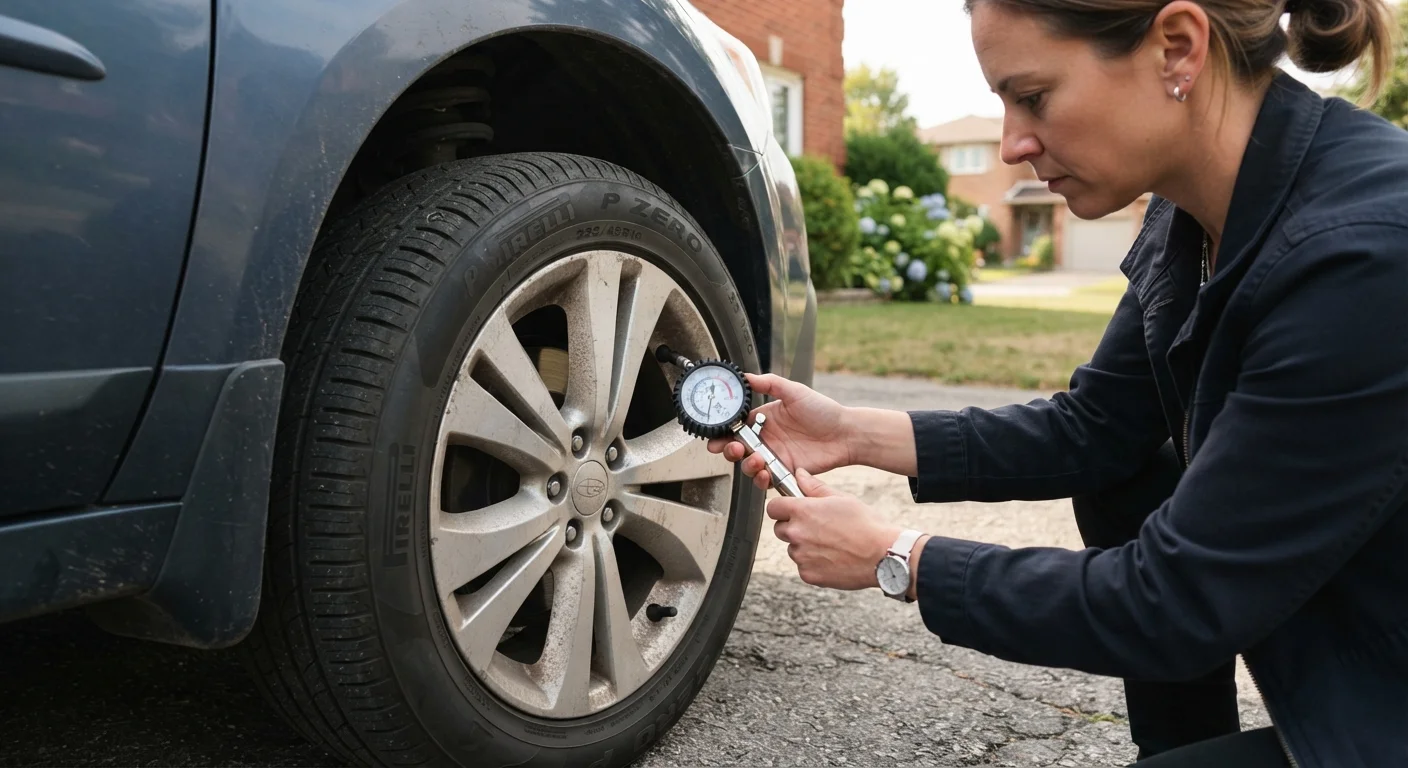
The number printed on a tyre's sidewall (e.g., "Max. Press. 51 PSI") is the maximum pressure the tyre can physically hold - not the correct inflation pressure for your vehicle. Using this figure can result in dangerous over-inflation. Always use the specification on your door jamb sticker or in your owner's manual.
What to Do With the Results
Once you've completed the checks above, you'll have four pressure readings and four sets of tread measurements. Here's how to interpret them:
- Pressure within 2 PSI of spec: You're in acceptable range. Recheck monthly.
- Pressure 5+ PSI below spec: Inflate immediately and inspect the valve stem and tyre surface for signs of a slow leak.
- Tread at 4/32" or less: Budget for replacement soon. This is the threshold where wet-weather performance degrades meaningfully.
- Tread at 2/32" or less: The tyre is at the US legal limit. Replacement is urgent.
If a tyre is consistently losing pressure between monthly checks, a professional inspection is warranted - the issue could be a faulty valve stem, a nail or debris puncture, or a bead leak where the tyre meets the rim. These are not DIY repairs.
Check All Four Tyres - Including the Spare
Pressure can vary between individual tyres due to slow leaks, temperature differences, or valve stem condition. Spend the extra minute to check every tyre, and don't forget the spare - a flat spare is useless in an emergency. If your vehicle has a compact spare, check its required pressure separately, as it often differs from the main tyres.
Keep in mind that aggressive driving habits - hard braking, fast cornering, and high-speed highway miles - all accelerate tread wear beyond typical rates. Our article on how driving habits quietly accelerate vehicle wear explains the mechanical detail behind this. And if you're budgeting for eventual tyre replacement, it's worth reviewing running costs that catch new car owners off guard, which covers how tyre expenses fit into the broader picture of vehicle ownership.
Worn Tyres Fail Faster in Wet Conditions
Tread channels exist to evacuate water from the contact patch between your tyre and the road. Once tread depth falls below 4/32", wet-weather stopping distances increase substantially. Do not delay replacement if your tyres are approaching this threshold, particularly heading into rainy or winter seasons.