What Each Policy Actually Covers
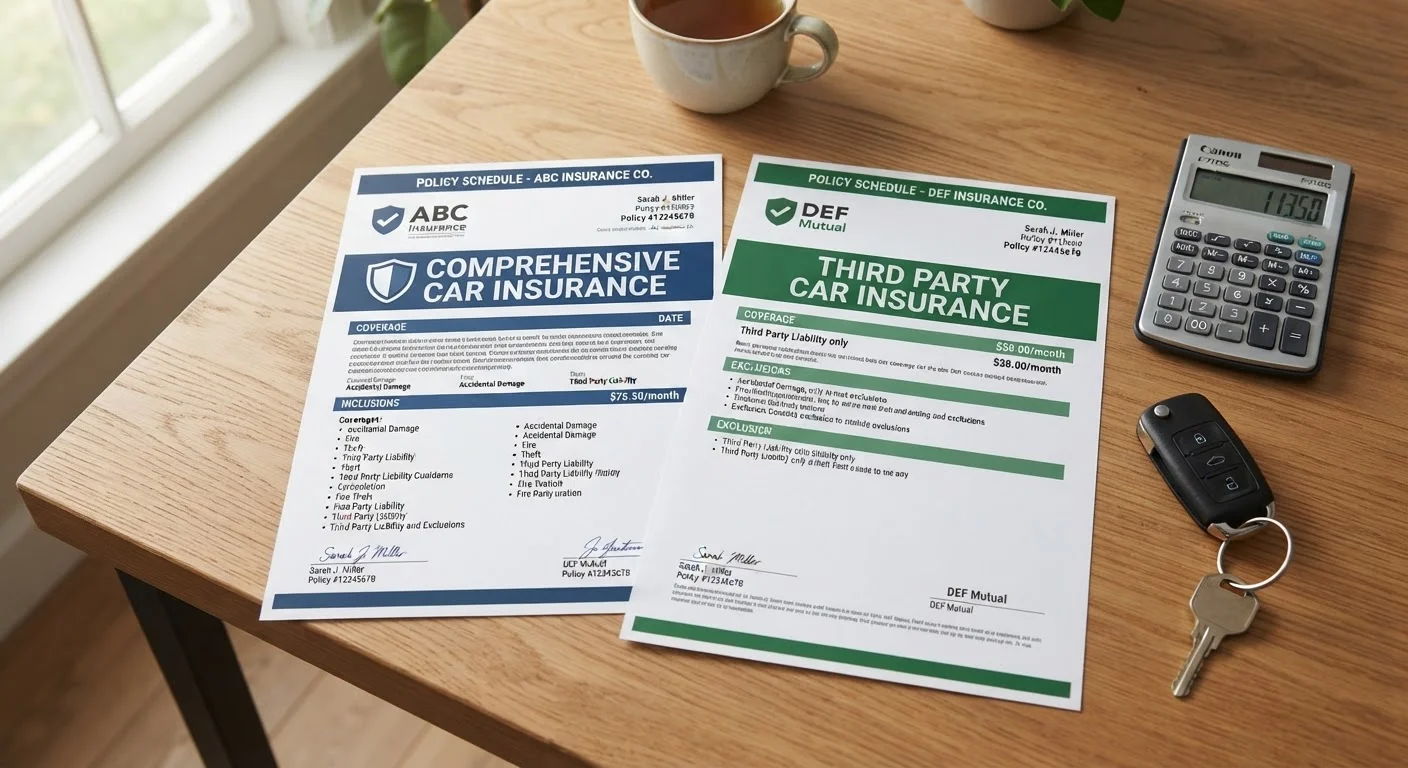
Car insurance is often described in tiers, and the gap between those tiers is where real financial exposure hides. Third-party insurance - the minimum required by law in most US states (usually called liability coverage) - pays for injuries and property damage you cause to other people in an accident. It does not pay for repairs to your own car, and it does not cover theft, fire, flooding, or any event where you're responsible for your own loss.
Comprehensive insurance is a package that layers additional protections on top of liability coverage. It typically includes collision coverage (repairs to your own vehicle after an accident, regardless of fault) and what's formally called "comprehensive" in policy documents - covering non-collision events like theft, vandalism, hail, floods, and hitting an animal. For a full breakdown of how each section of a policy works, see our guide to decoding car insurance policy language.
The practical difference: if you rear-end another car, third-party liability pays for the other driver's repairs. Comprehensive pays for yours as well.
| Criterion | Comprehensive Insurance | Third-Party Insurance |
|---|---|---|
| Damage to other people's property | Covered (liability portion) | Covered |
| Injuries to other drivers/pedestrians | Covered (liability portion) | Covered |
| Damage to your own vehicle in a collision | Covered (collision portion) | Not covered |
| Theft of your vehicle | Covered | Not covered |
| Weather damage (hail, flood, wind) | Covered | Not covered |
| Vandalism | Covered | Not covered |
| Animal collision (e.g. hitting a deer) | Covered | Not covered |
| Typical annual premium | Higher | Lower |
| Required by lenders/leasing companies | Usually yes | Usually no |
The Real Cost Calculation
Choosing the cheaper premium is not the same as choosing the cheaper option. Third-party-only cover costs less each month, but that saving disappears the moment you need to repair or replace your own vehicle. If your car is worth $12,000 and you cause a significant collision, you're absorbing that cost entirely - regardless of how many years of lower premiums you've banked.
~$2,000
Average annual comprehensive auto insurance cost in the US
According to the National Association of Insurance Commissioners (NAIC), average expenditure on auto insurance has risen steadily, with full-coverage policies significantly exceeding liability-only costs.
1 in 8
Drivers on US roads estimated to be uninsured
The Insurance Research Council has estimated that roughly one in eight drivers carries no insurance at all, increasing the risk exposure for those relying solely on third-party coverage.
$4,500+
Median cost of a single-vehicle collision repair
Industry data from auto repair associations suggests mid-range collision repairs routinely exceed this figure, making out-of-pocket risk substantial without own-vehicle coverage.
The calculus shifts with vehicle age and value. A car worth $3,000 may not justify comprehensive premiums of $1,200 or more per year, especially if the deductible (the amount you pay before coverage kicks in) is $1,000. In that scenario, your insurer's contribution to a total-loss claim might be minimal. Understanding how your deductible interacts with your vehicle's actual cash value is a critical part of this decision - and it's also part of the bigger picture covered in our full breakdown of vehicle ownership costs.
Premiums for comprehensive cover vary based on your driving history, location, the vehicle's make and model, your age, and your chosen deductible. Why your premium changes at renewal is worth understanding before you assume this year's rate will hold.
Deductibles Directly Affect Your Real-World Value
A higher deductible lowers your annual premium but raises the amount you must pay before your insurer contributes after a claim. If your chosen deductible is $1,500 and your car sustains $1,800 in damage, your insurer only contributes $300. Before selecting a deductible, consider whether you could comfortably cover that amount from savings in an emergency. This is general information only - consult a licensed insurance professional to evaluate the right structure for your situation.
Where the Gaps Catch Drivers Off Guard
Even comprehensive policies have exclusions that surprise drivers at claim time. Common gaps include: mechanical breakdown (not covered by either policy type), intentional damage, driving under the influence, and using a personal vehicle for commercial purposes without a commercial endorsement. Some policies also exclude specific weather events depending on your region.
Third-party policies have larger gaps by design. If your car is stolen, flooded, or destroyed in a fire, you receive nothing from a third-party-only policy. If you're in a hit-and-run accident where the other driver can't be identified, liability coverage from that driver doesn't exist - and your own property loss is unprotected unless you carry uninsured motorist property damage coverage or collision coverage.
Understanding these boundaries before you need to make a claim is far less stressful than discovering them afterward. The same principle applies across insurance types - whether it's car, travel, or pet coverage, the exclusions matter as much as what's included.