What Makes Yellowstone Genuinely Unique
Established in 1872, Yellowstone became the world's first national park - a landmark act of preservation that set a global precedent. Spanning roughly 2.2 million acres across Wyoming, Montana, and Idaho, the park isn't simply a pretty landscape. It is a living laboratory where geology, ecology, and human history intersect in ways found nowhere else on the planet.
Yellowstone contains more than half of the world's active geysers, thousands of hot springs, mud pots, and fumaroles (steam vents), all powered by a volcanic hotspot that has shaped this region for millions of years. Visitors who arrive expecting a typical mountain park are consistently surprised by how alien and dynamic the landscape feels - steaming vents beside pine forests, bison grazing near boiling pools, wolves howling across open valleys.
For curious travelers eager to explore America's depth, Yellowstone rewards preparation. The more you understand what you're looking at, the more extraordinary it becomes. If you're also drawn to destinations that offer rich experiences away from the mainstream, consider exploring lesser-known US destinations to round out your travels.
The Geology Beneath Your Feet
Yellowstone's dramatic surface features are the visible expression of a supervolcano - a volcanic system capable of eruptions far larger than conventional volcanoes. The Yellowstone Caldera, formed roughly 640,000 years ago, is approximately 30 by 45 miles wide. Scientists with the U.S. Geological Survey (USGS) monitor it continuously through seismic sensors and GPS measurements.
~500
Active geysers within Yellowstone
According to the National Park Service, this represents more than half of the world's total active geyser count.
2.2M
Acres in Yellowstone National Park
The park spans portions of Wyoming, Montana, and Idaho, making it larger than Rhode Island and Delaware combined.
11,000+
Years of Indigenous human presence
Archaeological research documented by NPS indicates human habitation of the Yellowstone region dating back at least 11,000 years.
Geothermal features fall into several categories worth distinguishing:
- Geysers - like Old Faithful - erupt when underground water, superheated by magma, builds pressure and bursts through a narrow channel. Yellowstone has roughly 500 active geysers.
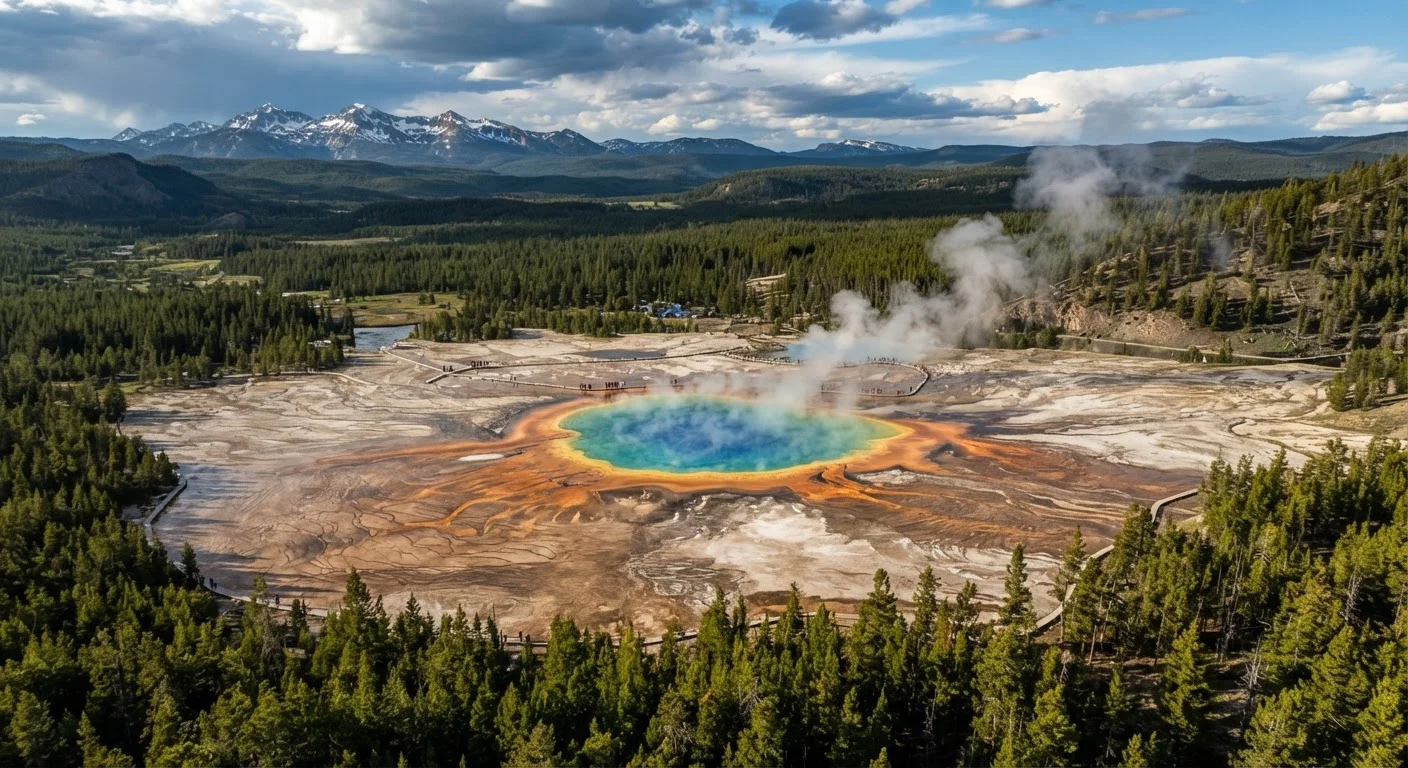
- Hot springs - including Grand Prismatic Spring - are large pools where water circulates freely and doesn't erupt. Their vivid colors come from heat-adapted microorganisms called thermophiles.
- Mud pots form where acidic gases break down rock into clay, creating bubbling, painterly pools.
- Fumaroles are vents that emit steam and gases where water evaporates before reaching the surface.
Thermal Areas Are Genuinely Dangerous
The ground near geothermal features can be paper-thin crust over boiling water or scalding mud. Boardwalks and designated paths are not suggestions - they are critical safety infrastructure. Serious burns and fatalities have occurred when visitors left marked areas. Always keep children within arm's reach in these zones, and treat every unmarked patch of ground as potentially hazardous.
The ground in many thermal areas is thin and unpredictable. Boardwalks exist because stepping off them - even briefly - can result in serious burns from superheated ground or collapse into a thermal feature. Every year, the park records incidents involving visitors who ignored these boundaries.
Wildlife: Who Actually Lives Here
Yellowstone's ecosystem is one of the most intact temperate ecosystems remaining in the world. The park and surrounding Greater Yellowstone Ecosystem support populations of animals that have vanished from most of the lower 48 states.
Notable species include:
- American bison - the park's roughly 5,000 bison represent one of the only continuously wild herds in the country.
- Gray wolves - reintroduced in 1995, wolves have reshaped the ecosystem in documented ways, helping restore riparian vegetation by changing elk behavior.
- Grizzly bears and black bears - both species are present and require serious awareness from visitors.
- Elk, pronghorn, bighorn sheep, moose - collectively forming one of North America's most diverse large-mammal assemblages.
Arrive at Lamar Valley at least 30 minutes before sunrise for the best odds of spotting wolves - they're most active in low-light hours and morning is when pack movements are easiest to observe.
Wolves in Yellowstone are most behaviorally active at dawn and dusk, and lower visitor presence in those windows reduces disturbance that causes wildlife to move out of open view.
Carry binoculars rated at least 8x42 magnification - wildlife in Yellowstone is often spotted at long distances across open valleys, and the naked eye simply won't do the experience justice.
The park's open terrain means animals are frequently visible but far away. Quality optics are consistently cited by experienced wildlife watchers as the single most impactful gear upgrade for a Yellowstone visit.
Birdwatchers will find osprey, bald eagles, sandhill cranes, and the rare trumpeter swan. The Lamar Valley, often called "America's Serengeti," offers some of the continent's most reliable wildlife viewing - especially at dawn and dusk.
History, Culture, and the Park's Origins
The narrative of Yellowstone didn't begin in 1872. Archaeological evidence indicates that Indigenous peoples - including ancestors of the Shoshone, Crow, Bannock, Blackfeet, and other nations - inhabited and traveled through the Yellowstone region for at least 11,000 years. The Shoshone-Bannock people, in particular, maintained continuous connections to the area that persisted through and beyond the park's establishment.
“The wonders of the Yellowstone region belong to all people, and preserving them was an act of extraordinary foresight - one that created a model the entire world has since followed.”
— National Park Service, Official steward of Yellowstone National Park since 1916
The 1872 act that created Yellowstone was pioneering, but it also displaced Indigenous communities from lands they had long used for hunting and gathering. Understanding this history is part of engaging with the park honestly. The National Park Service has worked in recent decades to acknowledge and incorporate Indigenous perspectives, and several tribal nations maintain formal relationships with the park today.
Early Euro-American exploration of the region was driven by trappers and Army expeditions. The Washburn-Langford-Doane Expedition of 1870 is often credited with galvanizing public support for protection, though Indigenous presence predated these accounts by millennia.
Seasonal Access and Planning Essentials
Yellowstone operates year-round, but each season presents a fundamentally different experience - and different logistics.
- Summer (June-August) - Peak season with all roads and facilities open. Expect significant crowds, especially at Old Faithful and Grand Prismatic. Advance lodging and camping reservations are strongly recommended, often months ahead.
- Fall (September-October) - A favorite among experienced visitors. Elk rut is active, crowds thin, and temperatures moderate. Most facilities remain open through early October.
- Winter (November-March) - Most roads close to wheeled vehicles. Snowcoach and snowmobile tours provide access to the interior. Wildlife is easier to spot against snow, and geothermal features are especially dramatic in cold air.
- Spring (April-May) - Roads reopen gradually. Newborn wildlife appears, wildflowers emerge, and rivers run high. Some areas remain muddy or snowbound into May.
Book Accommodations Far in Advance
In-park lodging at Yellowstone is managed through a single concessioner and books up months in advance for summer dates. If you're visiting between June and August, check availability six to twelve months out. Gateway towns like Gardiner, West Yellowstone, and Cody offer additional options, but these also fill quickly during peak season.
Entry to Yellowstone requires a fee (paid per vehicle or as part of an America the Beautiful annual pass). Check the official National Park Service website for current fee schedules, road status, and reservation systems - these details change seasonally.
Experiencing Yellowstone Responsibly
Yellowstone receives around 4 million visits annually. That scale creates real pressure on fragile ecosystems, and responsible behavior from each visitor genuinely matters.
Key principles endorsed by the National Park Service:
- Maintain at least 100 yards from bears and wolves, and 25 yards from all other wildlife - including bison, which injure more visitors than bears each year.
- Never feed wildlife. Human food alters animal behavior in ways that often lead to the animal's removal or death.
- Stay on designated trails and boardwalks near all thermal features, without exception.
- Pack out all trash. Leave No Trace principles apply throughout.
- Quiet hours in campgrounds help preserve the soundscape that makes the park special for everyone.
Yellowstone's scale can feel overwhelming, but focused exploration of one or two regions per visit is often more rewarding than rushing across the entire park. The Grand Loop Road connects major features and takes roughly 4-5 hours to drive uninterrupted - but a single afternoon in Lamar Valley or at Norris Geyser Basin can be more memorable than any highlight reel.
Altitude and Sun Exposure Matter
Much of Yellowstone sits above 7,000 feet in elevation. Visitors from lower altitudes may feel fatigue or mild altitude adjustment, especially when hiking. Sun intensity is also higher at elevation - sunscreen, a hat, and adequate hydration are practical necessities, not optional extras.
Planning a Yellowstone trip with meaningful context transforms a sightseeing stop into a genuinely formative experience. The ecology, geology, and human history here are layered and fascinating - and the park is big enough that even repeat visitors routinely discover something new.