
What Each Method Actually Involves
Massed practice - commonly called cramming - means concentrating study into one long, uninterrupted block close to a deadline. It feels productive because the material becomes temporarily familiar. Most students default to it because it requires no advance planning and delivers a quick sense of readiness.
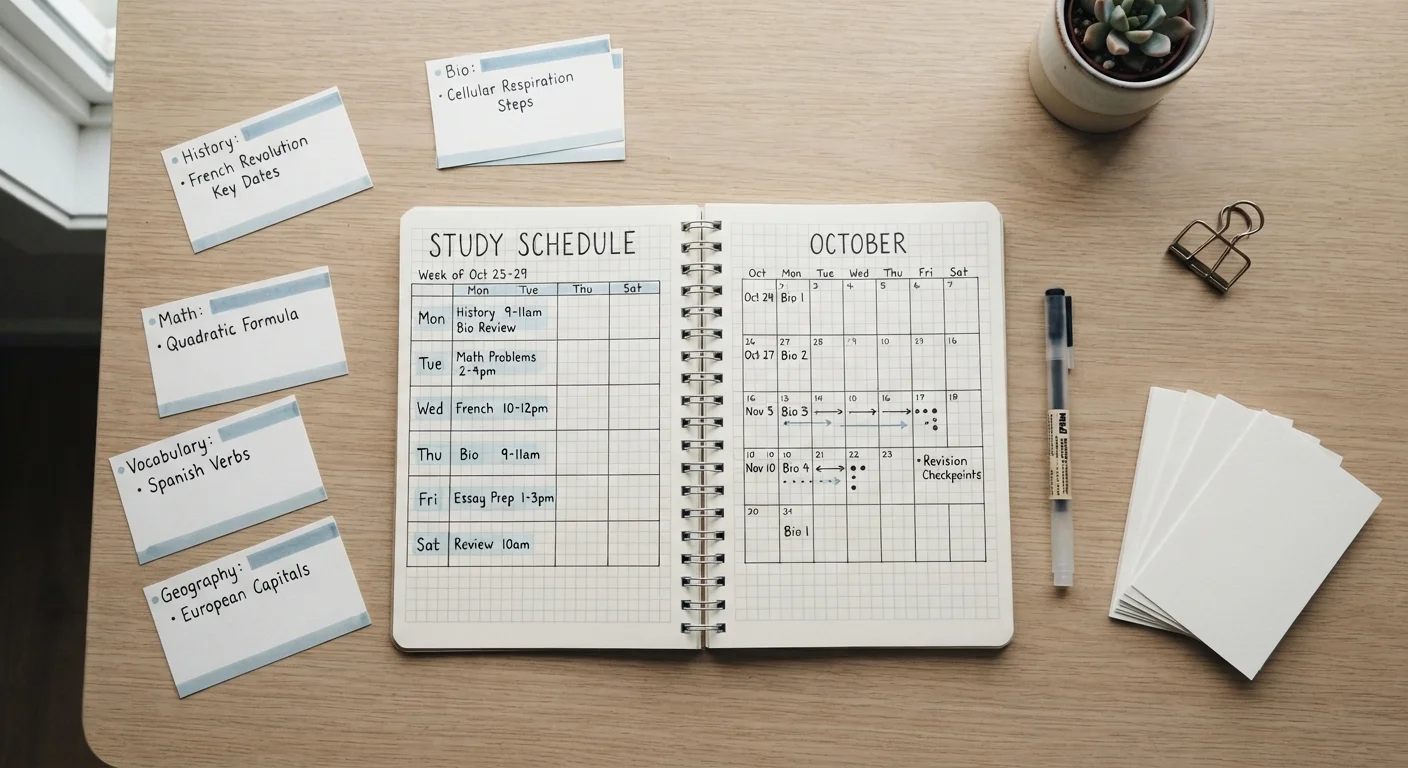
Spaced repetition distributes study across multiple sessions with deliberate gaps between them. Instead of reviewing material once in a marathon sitting, you revisit it after one day, then three days, then a week, and so on - each time reinforcing the memory just as it begins to fade. The intervals can be managed manually using a simple schedule or with flashcard systems designed around spaced algorithms.
The core difference is timing. Both methods can involve the same total study hours; what separates them is when those hours occur relative to each other and relative to the point of retrieval.
For a deeper look at how study technique choices connect to broader skill-building frameworks, see Atomic Habits vs. Deliberate Practice.
What the Evidence Says
The spacing effect - the finding that distributed practice produces stronger long-term retention than massed practice - is among the most replicated results in cognitive psychology. Researchers including Hermann Ebbinghaus documented it in the 19th century, and decades of subsequent laboratory and classroom studies have consistently confirmed it across age groups and subject areas.
200%+
Retention improvement over massed practice
Multiple meta-analyses in cognitive psychology literature suggest spaced practice can more than double long-term retention compared to equivalent massed study time.
~50%
Recall loss within one week after cramming
Research on the forgetting curve indicates that without review, a significant share of massed-practice gains are lost within days of the initial study session.
1-2 hrs/week
Typical maintenance load with spaced repetition
Learners using optimized spaced schedules can maintain large bodies of material with relatively brief weekly review commitments compared to periodic re-cramming.
The leading explanation involves memory consolidation. Each time you retrieve a memory after a gap, the act of retrieval strengthens the underlying neural pathways. When material is reviewed repeatedly in a single session, those pathways are still fresh and require little effort - meaning less consolidation occurs. Spacing forces the brain to work harder at each retrieval, and that effortful retrieval is precisely what builds durable memory.
Massed practice is not without value. Research shows it can produce rapid short-term familiarity, which matters when the goal is performance within the next 24-48 hours. The problem is the steep forgetting curve: studies routinely find that massed-practice gains decay sharply within days, while spaced gains remain relatively stable over the same period.
Passive vs. Active Learning explores a related distinction - one that complements the spacing debate well.
Head-to-Head: Key Differences at a Glance
The table below summarizes how the two approaches differ across dimensions that matter most to everyday learners.
| Criterion | Spaced Repetition | Massed Practice |
|---|---|---|
| Session structure | Multiple short sessions over days/weeks | One or few long uninterrupted blocks |
| Short-term recall | Moderate after first session | High immediately after cramming |
| Long-term retention | Significantly stronger | Fades sharply within days |
| Planning required | Yes - advance scheduling needed | Minimal - works on short notice |
| Cognitive effort per session | Lower per session, higher cumulative value | High intensity, diminishing returns |
| Best time horizon | Weeks, months, or years | 24-48 hours |
| Research support | Extensive, consistent across domains | Limited to short-term gains |
Notice that massed practice is not categorically inferior - context determines which trade-offs are acceptable. The critical variable is your time horizon: when do you need the knowledge, and for how long?
Putting Spaced Repetition Into Practice
Getting started with spaced repetition does not require specialized software. A simple approach:
- Break material into small, discrete units. Individual facts, vocabulary words, formulas, or concepts work better than broad topic summaries.
- Schedule review sessions in advance. After your first exposure, plan a review for the next day, then three days later, then a week later. Adjust intervals based on how confidently you recall each item.
- Test yourself rather than re-read. The retrieval attempt is what drives consolidation. Covering a definition and recalling it from memory is more effective than reading it again. This connects directly to active recall principles.
- Be consistent over ambitious. Fifteen focused minutes daily outperforms a three-hour session once a week for long-term retention goals.
For learners who want to explore how spacing interacts with varied practice types, interleaving vs. blocking adds another useful layer to the picture.
Spaced Repetition and Active Recall Work Best Together
Spacing tells you when to review; active recall tells you how to review. Using both simultaneously - retrieving answers from memory at spaced intervals rather than passively re-reading notes - produces greater retention gains than either technique alone. If you can only adopt one habit, prioritize self-testing over spaced scheduling; but combining both is the stronger approach supported by the research literature.
Choosing the Right Method for Your Situation
Most learners benefit from leaning heavily toward spaced repetition as a default, with massed practice reserved for genuine emergencies. A few questions to guide your decision:
- How soon do you need the information? If it is tomorrow, massed practice may be your only option. If it is two weeks away, spaced sessions will outperform a single cram block.
- How long do you need to retain it? One-time recall needs (a presentation you will never give again) tolerate massed practice. Professional knowledge, academic subjects, or language skills demand spaced approaches.
- What is the cost of forgetting? In high-stakes domains - medical training, safety procedures, cumulative subjects like mathematics - forgetting is costly. Spaced repetition reduces that risk meaningfully.
Combining spaced repetition with habits common to fast learners creates a compounding effect that casual study methods simply cannot match over time.