
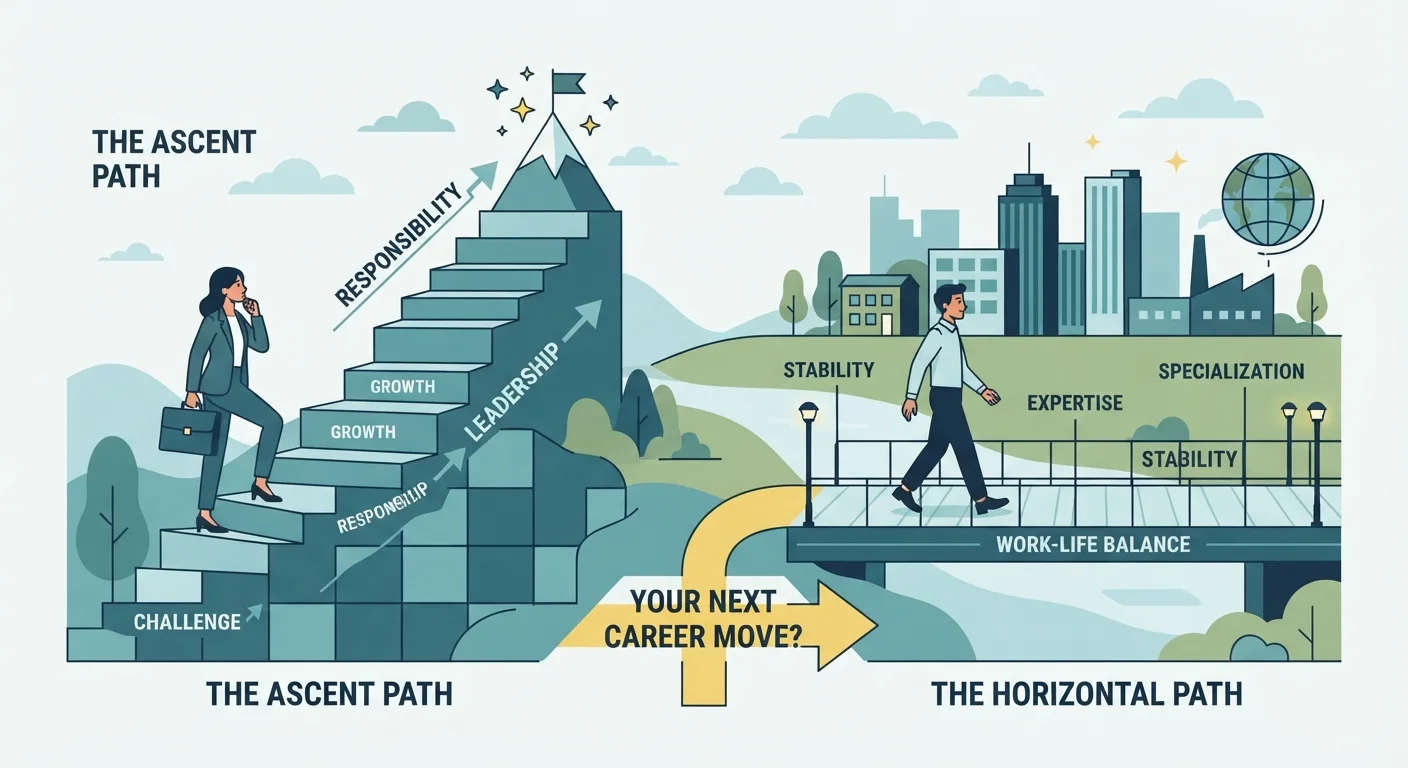
What Each Type of Move Actually Means
A vertical career move is what most people picture when they think of advancement: a promotion that brings a new title, higher pay, and more responsibility - often including managing others. A lateral career move involves shifting into a different role or team at roughly the same organizational level, without an immediate title bump or pay increase.
Both are legitimate strategies for professional growth, yet lateral moves are routinely underestimated. Research in career development consistently shows that professionals who accumulate cross-functional experience tend to be stronger candidates for senior leadership over time - not despite their lateral moves, but partly because of them.
If you're just building your professional foundation, see our guide to starting your career from scratch for context on how early decisions shape long-term trajectories.
| Criterion | Vertical Move | Lateral Move |
|---|---|---|
| Compensation impact | Typically immediate increase | Often pay-neutral short term |
| Skill development | Deepens existing expertise | Builds cross-functional breadth |
| Risk level | Higher if not yet ready to lead | Lower - same seniority level |
| Speed of advancement | Faster title progression | Slower title, stronger long-term foundation |
| Engagement impact | Motivating if role is a fit | Can restore energy and curiosity |
| Leadership readiness | Requires proven management readiness | Builds broader leadership perspective |
| Career pivot potential | Limited within one function | High - opens new domains |
The Real Trade-Offs: Upward vs. Sideways
Vertical moves offer clear, immediate rewards: higher compensation, formal authority, and recognition that your performance has been noticed. But they also carry real demands. Moving into management, for example, shifts your primary job from executing tasks to enabling others - a fundamentally different skill set. Many talented individual contributors struggle with this transition if they pursue it before they're ready.
Lateral moves, by contrast, ask you to accept short-term ambiguity in exchange for long-term optionality. You may take a pay-neutral step while learning a new function, which can feel like standing still - even when you're building capabilities that make you far more competitive later. The transferable skills you develop through lateral experience are often what distinguish strong managers from exceptional senior leaders.
~50%
Of senior leaders have cross-functional experience
LinkedIn's Global Talent Trends research has consistently found that executives in broad leadership roles are more likely to have held roles across multiple functions earlier in their careers.
1 in 3
Employees cite lack of growth as reason for leaving
Gallup workplace surveys regularly identify limited advancement opportunity as one of the top three reasons employees voluntarily leave their organizations.
One overlooked risk of always moving vertically: depth without breadth. A professional who has only moved upward within a single function may find their advancement stalls when organizations seek leaders who can coordinate across departments, manage competing priorities, or step into broader roles.
When to Move Up, When to Move Sideways
The right move depends on where you are in your career arc and what gaps currently limit you. Ask yourself three diagnostic questions:
- Am I underutilized or have I plateaued? If your current role no longer stretches you, a lateral move into unfamiliar territory may restore challenge and growth more effectively than waiting for a promotion.
- Do I have gaps in influence or visibility? Vertical moves require that decision-makers see you as ready. If you suspect that awareness - not capability - is the barrier, read about why capable professionals get overlooked for promotions before pursuing an upward push.
- Am I building toward a specific senior role? If the position you ultimately want requires cross-functional credibility, a lateral move now may be the most direct route there, even if it looks indirect on paper.
For those considering a more significant shift - changing industries or functional areas entirely - our comprehensive guide to career pivots walks through the key factors to weigh.
Lateral Moves and Compensation: Know Your Position
Accepting a lateral move doesn't mean accepting a pay freeze indefinitely. Before making the move, negotiate a clear performance timeline: agree on what success looks like in the new role and when compensation will be revisited. Framing the lateral move as an investment with a defined review point protects your interests while demonstrating good faith. For broader budgeting context as you plan any career transition, it helps to have a solid personal financial baseline - see our overview of budgeting basics.
Making Either Move Work for You
Whichever direction you choose, intentionality is what separates strategic moves from reactive ones. Before committing, document what the move is designed to achieve: a new skill set, a compensation milestone, exposure to a specific business unit, or a path to a defined target role.
For vertical moves, prepare by demonstrating readiness before the conversation happens. If you want to know how to frame a promotion discussion effectively, our article on asking for a promotion covers timing and framing in detail.
For lateral moves, treat the transition as an investment. Communicate clearly to your manager and peers what you're building toward, so the move reads as strategic growth rather than dissatisfaction. Consider whether working with a career coach could help you structure the transition - our overview of what career coaching offers can help you decide if that's the right support for your situation.
Careers rarely move in a straight line. The most resilient professionals treat both vertical and lateral moves as tools in a larger strategy - choosing based on what their next chapter genuinely requires, not just what looks most impressive on a résumé.