How the Brain Builds a Habit
Every habit you have - good or bad - follows the same underlying neurological blueprint. Behavioural scientists describe this as the habit loop: a three-part cycle of cue, routine, and reward. A cue signals the brain to initiate a behaviour; the routine is the behaviour itself; and the reward is what tells the brain the loop is worth repeating.
Over time and with repetition, this loop becomes encoded in the basal ganglia - a region of the brain associated with automatic, procedural behaviour. As the pattern solidifies, the prefrontal cortex (the seat of conscious decision-making) is progressively less involved. This is why a well-established habit feels nearly effortless: the brain has essentially offloaded the task.
This efficiency is a feature, not a flaw. It frees up cognitive resources for more demanding decisions. The challenge arises when the same process locks in behaviours we would rather change.
66 days
Average time for a habit to become automatic
According to a study published in the European Journal of Social Psychology by Phillippa Lally and colleagues, automaticity averaged 66 days, ranging from 18 to 254 days across participants.
40%
Of daily actions driven by habit, not decision
Research from Duke University estimated that roughly 40% of the actions people perform each day are habits rather than deliberate choices.
~3x
Greater success with implementation intentions
Meta-analyses on implementation intentions - specific if-then plans - show they can significantly increase the likelihood of following through on intended behaviours compared to vague goals.
Why Some Routines Stick - and Others Fall Apart
Not all habits are equally easy to form. Research points to several factors that determine whether a new behaviour takes hold or fades within days.
- Clarity of the cue: Vague intentions like "I'll exercise more" rarely produce lasting habits. Attaching a behaviour to a specific, reliable trigger - such as "after I pour my morning coffee" - dramatically improves follow-through. This is sometimes called implementation intention in behavioural research.
- Immediate reward: The brain responds more powerfully to rewards that arrive quickly. If a habit only pays off weeks or months later (such as eating well for long-term health), pairing it with an immediate, small reward can bridge the gap.
- Reduced friction: The fewer obstacles between a cue and a behaviour, the more likely the habit will form. Laying out workout clothes the night before, for instance, lowers the activation energy required to exercise.
- Consistency of context: Habits form faster when performed in the same environment and at the same time. Variety, while valuable elsewhere, works against automaticity in the early stages of habit-building.
For a deeper look at evidence-based strategies, see building habits that actually stick.
Use Habit Stacking for Faster Results
Identify one behaviour you already do reliably every day - brewing coffee, brushing teeth, sitting down at your desk. Then attach a new, small habit to immediately follow it. This "habit stacking" technique borrows the neural strength of an existing routine to anchor the new behaviour, reducing how long it takes to become automatic.
The Role of Environment Over Willpower
One of the most consistent findings in habit research is that willpower is an unreliable tool for sustaining behaviour change. Willpower draws on the same limited cognitive resources as decision-making and stress management - meaning it is most depleted precisely when you need it most.
Environment design, by contrast, works passively. Placing healthier food at eye level in the refrigerator, keeping your phone out of the bedroom to improve sleep, or setting up a dedicated workspace to support focus - these structural changes support desired behaviours without requiring ongoing mental effort.
“The difference between who you are and who you want to be is what you do. Environment is the invisible hand that shapes human behaviour.”
— BJ Fogg, Behaviour scientist and author, Stanford University
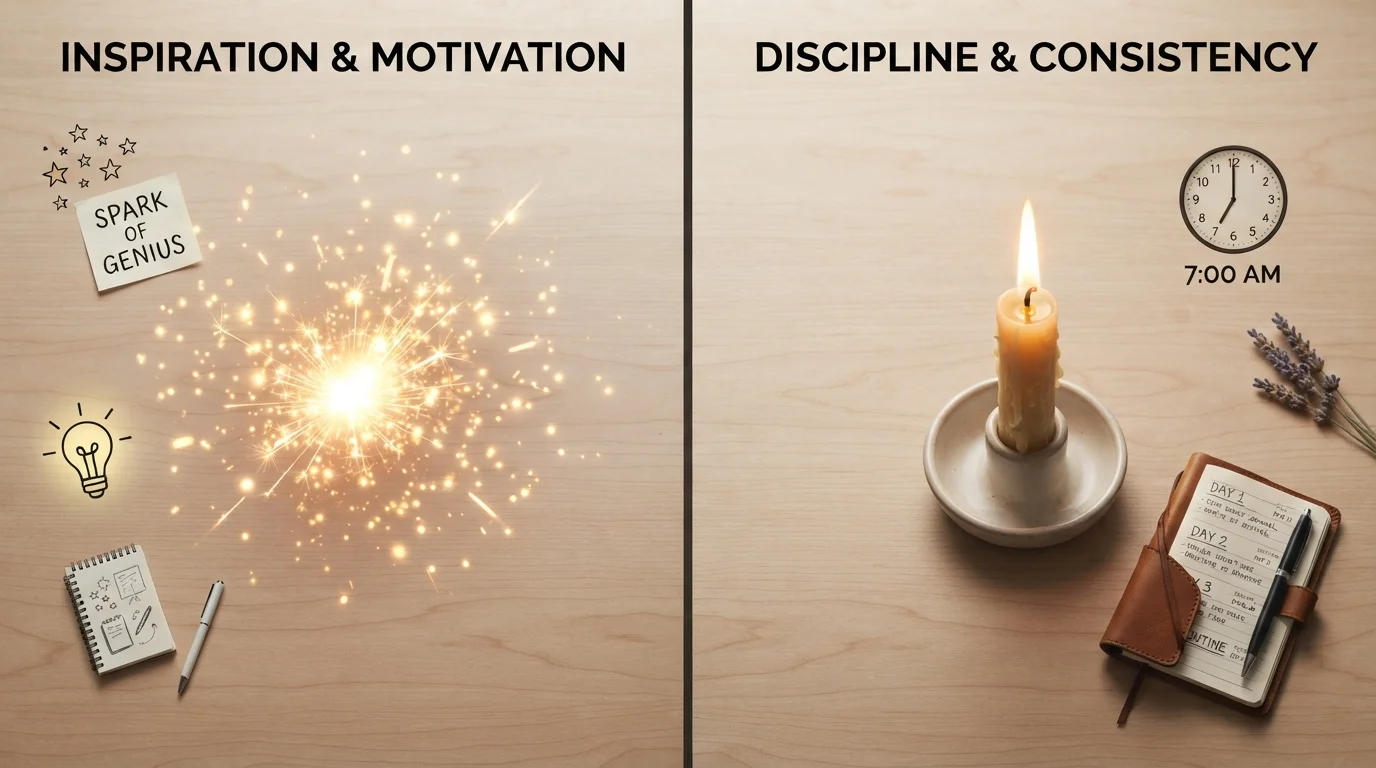
This is also why motivation vs. discipline is such a practically important distinction: motivation is emotional and variable, while systems and environments create the conditions where discipline becomes less necessary.
For long-term sustainability, the goal is not to rely on trying harder - it is to design a context where the desired behaviour becomes the path of least resistance.
Applying the Science to Everyday Life
Understanding habit formation is only useful when it translates into realistic daily practice. Here are the principles the research supports most strongly:
- Start smaller than feels necessary. Tiny habits - as small as a single push-up or a two-minute walk - are far more likely to become automatic than ambitious routines that demand high motivation upfront.
- Stack new habits onto existing ones. Using a current behaviour as a cue for a new one ("after I brush my teeth, I'll take my vitamins") leverages an already-established neural pathway.
- Expect a plateau before automaticity. Early habit formation often feels rewarding; the weeks that follow can feel like friction. This is normal - the brain is still encoding the routine. Consistency during this phase is what determines whether the habit lasts.
- Design for lapses, not perfection. Planning what you will do when you miss a day removes the decision-making burden in the moment. Consistency over time matters far more than flawless execution. For more on this, see consistency over perfection.
Individual Timelines Vary Widely
The science shows significant variation in how quickly habits form between individuals. Factors such as stress levels, sleep quality, mental health, and the complexity of the habit all play a role. If a new routine is taking longer than expected to feel automatic, that is normal - not a sign of failure. Adjusting the size or context of the habit is often more effective than simply trying harder.
This article is for general informational and educational purposes only and is not a substitute for advice from a qualified healthcare professional. If you have concerns about your health or wellbeing, please consult a licensed provider.