
What Each One Actually Means
Before comparing them, it helps to define both terms clearly - because they're often used interchangeably when they describe genuinely different phenomena.
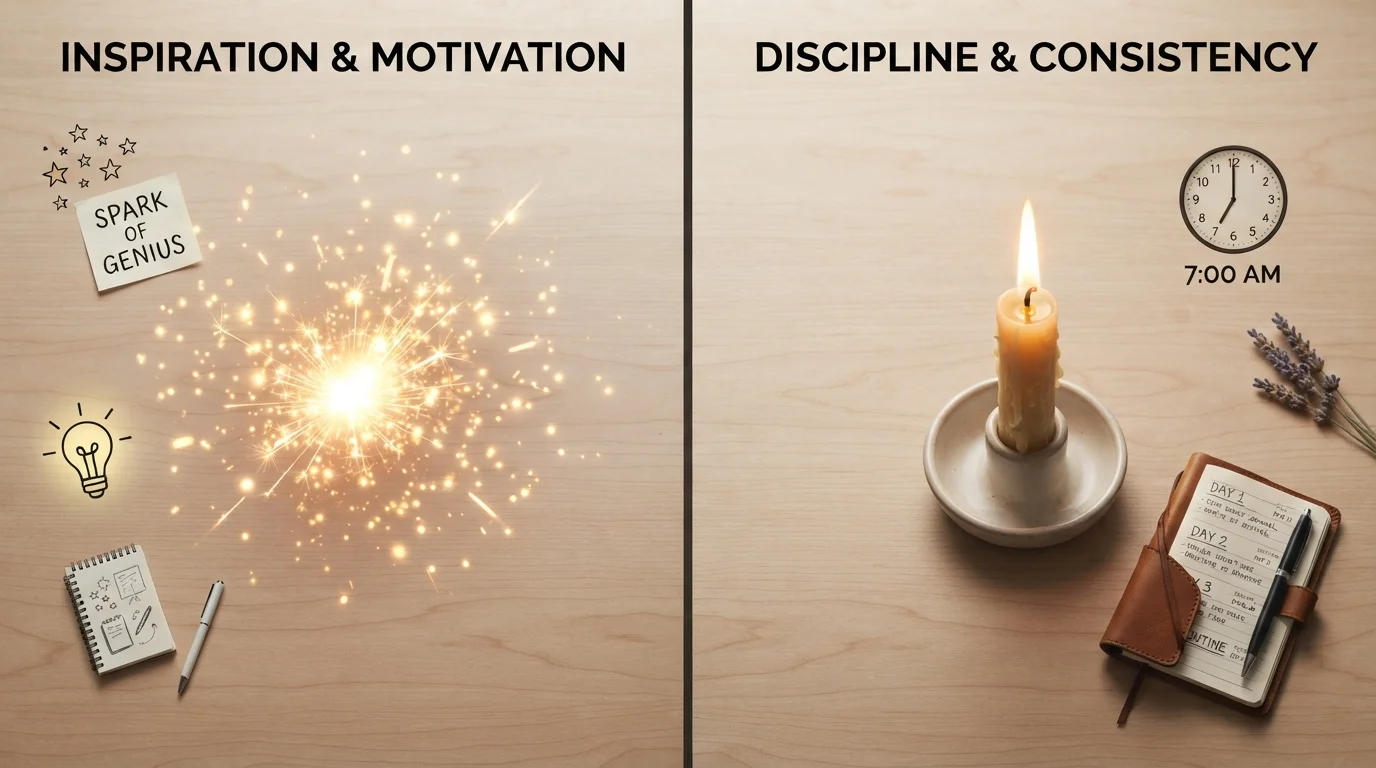
Motivation is a psychological and emotional state. It arises when you feel excited about a goal, connected to a purpose, or energized by a potential reward. Researchers broadly categorize it as either intrinsic (driven by internal satisfaction) or extrinsic (driven by external rewards or consequences). By its nature, motivation fluctuates - it responds to mood, environment, sleep, stress, and a dozen other variables outside your control.
Discipline, by contrast, is a practiced behavior - a commitment to follow through on a chosen course of action independent of how you feel in the moment. It isn't about having iron willpower or punishing yourself into productivity. It's about designing your behavior so that action becomes the default, not the exception. For a deeper look at the concepts underpinning self-discipline, see our complete reference on self-discipline.
| Criterion | Motivation | Discipline |
|---|---|---|
| Nature | Emotional state; fluctuates | Practiced behavior; trainable |
| Reliability | Unreliable; mood-dependent | Consistent when systems are in place |
| Best used for | Launching goals, finding purpose | Sustaining effort over time |
| Source of energy | Excitement, desire, external triggers | Commitment, routine, habit |
| What it requires | The right emotional conditions | Pre-set systems and structure |
| Risk if over-relied on | Inconsistency, burnout, procrastination | Rigidity or joyless compliance |
| Grows stronger with | Clear goals, meaningful 'why' | Repetition, small wins, habit loops |
Why Motivation Alone Isn't Enough
Motivation gets a great deal of cultural praise - motivational quotes, hype videos, and inspiration-driven productivity content dominate the self-improvement space. And motivation is valuable: it clarifies what matters to you and provides an initial burst of energy. But there's a structural problem with depending on it.
Motivation is reactive. It tends to appear when conditions are favorable - when you're rested, when a goal feels fresh, when external circumstances line up. It tends to disappear when life gets busy, when progress slows, or when early effort doesn't produce visible results. This is sometimes called the motivation gap: the distance between your inspired intentions and your on-the-ground behavior when enthusiasm fades.
~43%
Of daily behaviors performed out of habit
Research published in the journal Psychological Science estimates that roughly 43% of everyday behaviors are performed habitually, without active decision-making.
66 days
Average time for a new behavior to become automatic
A University College London study found that on average, it takes about 66 days for a new behavior to become automatic, though the range varied widely among participants.
Research in behavioral psychology suggests that people who frame self-improvement as requiring the right feeling before acting are more likely to procrastinate and give up than those who focus on structure and routine. The feeling rarely arrives on demand.
How Discipline Fills the Gap
Discipline doesn't ask whether you feel like doing something - it assumes you won't always feel like it, and builds accordingly. Rather than waiting for motivation to arrive, disciplined people have pre-committed to specific actions at specific times, reducing the friction of decision-making in the moment.
Practically, this means building systems: a fixed workout time instead of "whenever I feel like it," a writing block on the calendar instead of "when inspiration strikes," a savings transfer that happens automatically rather than when you remember. These systems matter because they offload willpower to structure.
Importantly, discipline doesn't mean white-knuckling through everything. It often means making the desired behavior easier to do consistently - a concept closely related to habit formation. Our article on building habits that actually stick explores the neurological foundations of this process in depth.
Willpower Is a Limited Resource
Self-control research, including work associated with the concept of ego depletion, suggests that exerting willpower repeatedly in a single day can reduce its effectiveness later on. This is one reason why building external systems and routines matters: they reduce the number of decisions your willpower has to manage. Rather than fighting your own resistance every day, well-designed habits make the desired action the path of least resistance.
The Smarter Approach: Using Both Strategically
The real insight isn't that discipline is superior and motivation is useless - it's that they serve different functions at different stages of any growth process.
Use motivation to set direction. When you're clarifying a goal, exploring what genuinely matters to you, or rebuilding after a difficult period, engaging your motivational drive is exactly right. Let your enthusiasm inform your vision.
Use discipline to maintain momentum. Once the direction is clear, put systems in place that don't rely on daily re-inspiration. Schedule your actions, reduce obstacles, and commit to showing up consistently - even imperfectly.
Over time, disciplined repetition often generates its own motivation. Completing a workout you didn't feel like doing produces a sense of accomplishment that reinforces further effort. Progress, however incremental, is one of the most reliable motivators there is. You can explore how these two paths to improvement interact further in our comparison of atomic habits vs. deliberate practice.
The goal isn't to choose one over the other. It's to understand which tool you need right now - and reach for it deliberately. For guidance on what makes routines last, see our piece on consistency over perfection.