
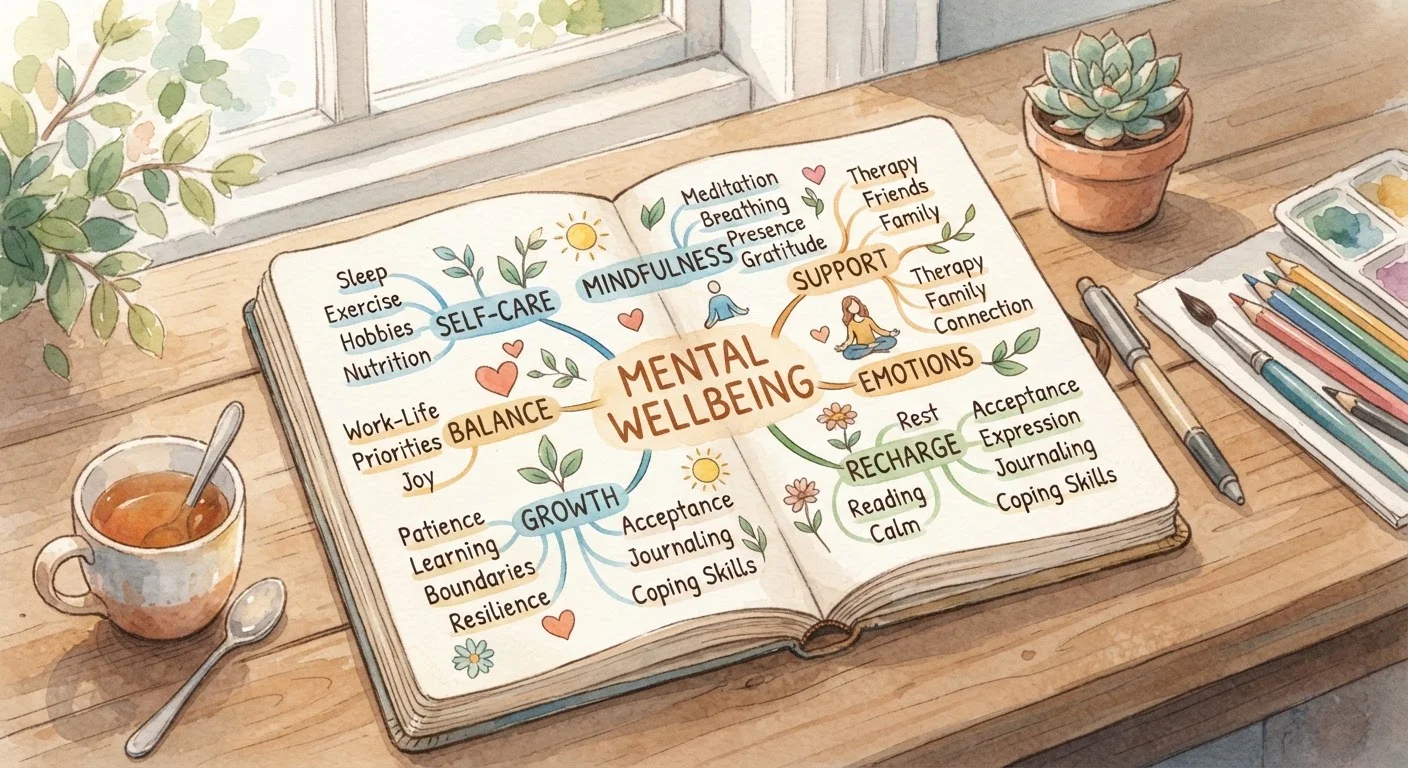
Why Mental Health Language Matters
Mental health conversations are everywhere - in therapy offices, workplace wellness programs, social media, and daily self-care routines. Yet the vocabulary used in those conversations can feel opaque or intimidating, making it harder for people to understand their own experiences or communicate them clearly to others.
This reference guide translates the most commonly encountered mental health terms into plain, accessible language. It is intended as general educational information, not a diagnostic tool or substitute for professional mental health care. For personal concerns, always consult a qualified mental health professional.
Familiarity with these terms can help you ask better questions, engage more meaningfully with care providers, and feel less alone when navigating emotional challenges. Whether you are supporting someone else or exploring your own daily self-care, understanding the language is a practical foundation.
Anxiety
A state of persistent worry, unease, or fear that is out of proportion to the situation triggering it. Anxiety exists on a spectrum - from everyday nervousness to clinically significant anxiety disorders that interfere with daily functioning.
Burnout
A state of chronic stress that leads to physical and emotional exhaustion, cynicism, and a sense of reduced accomplishment. It is most often associated with prolonged workplace stress but can result from any sustained high-demand situation.
Cognitive Distortion
An exaggerated or irrational thought pattern that negatively affects mood and behavior. Common examples include all-or-nothing thinking, catastrophizing, and overgeneralization. Identifying distortions is a core skill in cognitive behavioral therapy.
Dysregulation
Difficulty managing emotional responses in a way that feels proportionate to circumstances. Someone who is dysregulated may experience intense emotions that are hard to calm, often as a result of stress, trauma, or an underdeveloped coping skill set.
Neuroplasticity
The brain's ability to reorganize itself by forming new neural connections throughout life. This property underpins how therapy, learning, and consistent mental health practices can lead to lasting changes in thought patterns and emotional responses.
Trauma
An emotional response to a deeply distressing or disturbing event that overwhelms an individual's ability to cope. Trauma can be acute (a single event), chronic (repeated exposure), or complex (multiple adverse experiences over time).
Mindfulness
The practice of deliberately paying attention to the present moment - thoughts, feelings, and sensations - without judgment. Rooted in contemplative traditions and studied extensively in clinical psychology, mindfulness is associated with reduced stress and improved emotional regulation.
Psychotherapy
A broad term for professional, structured talk-based treatment aimed at improving mental health. Many approaches exist, including cognitive behavioral therapy (CBT), dialectical behavior therapy (DBT), and psychodynamic therapy, each with distinct methods and goals.
Resilience
The capacity to recover from adversity, adapt to challenging circumstances, and continue functioning. Resilience is not an innate trait but a set of skills and resources that can be developed over time.
Stigma
Negative attitudes, stereotypes, or discrimination directed at people with mental health conditions. Stigma can be social (from others) or internalized (held by the individual themselves), and it remains one of the most significant barriers to people seeking care.
Coping Strategy
Any conscious or habitual behavior used to manage stress or difficult emotions. Coping strategies are broadly categorized as adaptive (healthy, effective) or maladaptive (short-term relief that creates longer-term problems).
Emotional Regulation
The ability to influence which emotions one experiences, when one experiences them, and how they are expressed. Strong emotional regulation skills are linked to better relationships, mental well-being, and overall life satisfaction.
Key Concepts at a Glance
The following quick-reference facts provide useful context about mental health as a field - including how common these experiences are and how the language has evolved over time.
| Adults affected by mental illness annually (US) | Approximately 1 in 5 (National Institute of Mental Health (NIMH)) |
| Most common mental health conditions | Anxiety disorders, depression, PTSD (NIMH, general epidemiological data) |
| Primary clinical reference for diagnoses | DSM-5-TR (Diagnostic and Statistical Manual) (American Psychiatric Association) |
| Age when half of lifetime mental illness begins | By age 14 (NIMH research summary) |
| Median delay between symptom onset and treatment | 11 years (NIMH, widely cited figure) |
| Scope of psychotherapy types in clinical use | Over 400 recognized approaches (Mental health research literature, general estimate) |
Mental health terminology continues to develop as research advances. Some older clinical labels have been retired in favor of more precise or respectful language, and terms that once belonged only to clinical settings - like trauma or dysregulation - are now widely used in everyday conversation. That shift is largely positive, but it also means definitions can vary between contexts. When in doubt about a specific term as it applies to your situation, a licensed clinician is the most reliable source.
Language Evolves - So Do Definitions
Mental health terminology is not fixed. Clinical editions like the DSM are periodically updated, retiring outdated labels and refining diagnostic criteria as evidence accumulates. Terms popularized on social media - such as 'gaslighting' or 'narcissist' - often carry looser meanings than their clinical counterparts. When precision matters, rely on definitions from qualified professionals or peer-reviewed sources rather than informal usage.
For readers interested in how plain-language glossaries work across other life domains, similar reference guides exist for financial debt terminology and learning science concepts - each designed to make specialist vocabulary approachable.
This article is for informational and educational purposes only. It does not constitute medical or psychological advice and is not a substitute for consultation with a qualified mental health professional.