
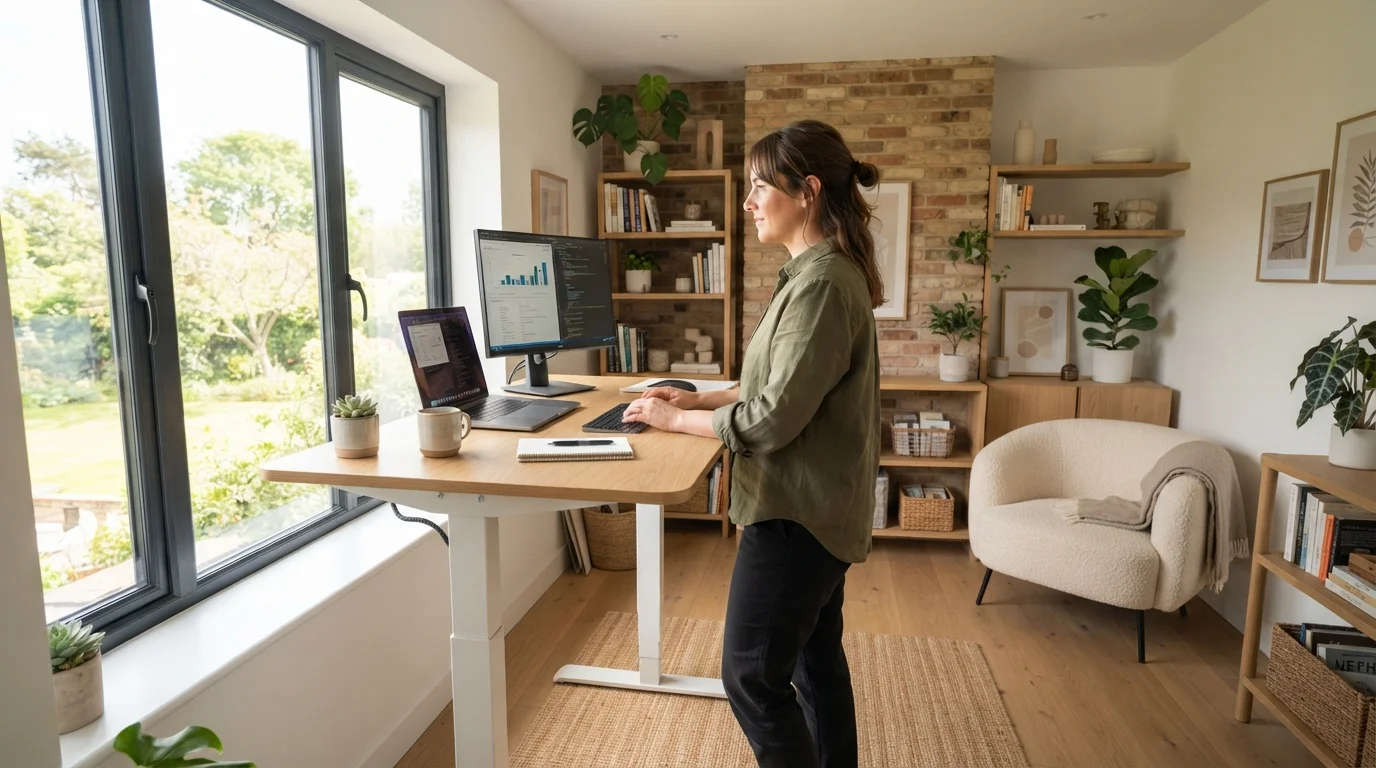
Defining Sedentary Behaviour - It's More Specific Than You Think
Most people use "sedentary" as a loose synonym for "inactive" or "lazy," but researchers apply a precise definition. Sedentary behaviour refers to any waking activity that involves sitting, reclining, or lying down with an energy expenditure of 1.5 metabolic equivalents (METs) or fewer. That's the energy your body burns at rest. In practical terms, it includes desk work, watching television, driving, and reading in a chair - but not sleeping, which is categorised separately.
This distinction matters because it shifts the conversation away from how much exercise someone gets and toward how much of each day is spent in low-effort, seated postures. A person can meet recommended physical activity guidelines and still accumulate many hours of sedentary time daily - and evidence suggests that combination carries its own health implications.
Understanding this baseline is essential before evaluating popular fixes like standing desks, fidget-friendly chairs, or "movement snacks." Not all interventions address what the science actually identifies as the problem. If you're also thinking about the psychological side of building new movement habits, the science of behaviour change offers useful context on why good intentions often stall.
Common Myths - and What the Evidence Actually Shows
Several widely held beliefs about sedentary behaviour misread or oversimplify the research. The myth-and-fact pairs below address the most persistent ones.
Myth
Standing at a desk instead of sitting is enough to counteract sedentary behaviour.
Fact
Standing burns only marginally more energy than sitting and does not replicate the benefits of actual movement.
Standing desks became popular after observational studies linked prolonged sitting to poorer health outcomes. However, subsequent research - including a 2018 study published in the European Journal of Preventive Cardiology - found that standing burns approximately 0.15 more calories per minute than sitting. Over a workday, this is a negligible difference. Prolonged standing also carries its own risks, including lower limb discomfort and fatigue. The evidence favours moving, not merely changing posture.
Myth
If you exercise for 30-60 minutes a day, your sitting time doesn't matter much.
Fact
Research indicates that high volumes of sitting are associated with health risks even in people who meet exercise guidelines.
This is sometimes called the "active couch potato" paradox. Studies - including large meta-analyses examining cardiovascular and metabolic outcomes - have found that people who sit for many hours daily show elevated risk markers even when they engage in regular structured exercise. Current thinking suggests that exercise and reducing sedentary time are independent factors, not interchangeable ones. Both matter.
Myth
Sedentary behaviour only becomes a problem if you sit for many consecutive hours without any break.
Fact
Even shorter uninterrupted sitting bouts can have measurable effects on circulation and blood glucose when they occur repeatedly throughout the day.
Laboratory studies that have participants sit for as little as one to two hours without interruption have observed changes in leg blood flow and postprandial (after-meal) blood glucose levels. While a single sitting bout is not a clinical event, the cumulative pattern across a day and across years is what researchers consider problematic. Frequency of interruption appears to matter, not just total daily sitting time.
Myth
Sedentary behaviour is the same as not exercising.
Fact
Sedentary behaviour and physical inactivity are distinct concepts measured differently and associated with different outcomes.
Physical inactivity refers to not meeting recommended levels of moderate-to-vigorous physical activity - typically 150 minutes per week for adults under US and WHO guidelines. Sedentary behaviour is measured separately, as the total time spent in low-energy seated or reclined states. A person can be physically active by guideline standards and still be highly sedentary. Research on each behaviour uses different methodologies and has identified somewhat different health associations, which is why conflating the two leads to incomplete recommendations.
Myth
Wearable step counters accurately measure whether you're sedentary.
Fact
Step counts are a proxy for activity, not a direct measure of sedentary time, and many devices undercount sedentary periods during activities like cycling or driving.
Consumer-grade step trackers measure ambulatory movement well but are poor at capturing stationary sedentary time during non-ambulatory activities. Research-grade sedentary measurement uses accelerometers worn on the hip that record total movement across all axes. Step count goals - such as 10,000 steps - are useful motivational tools but should not be confused with a complete picture of sedentary behaviour. Someone who walks 10,000 steps but sits for nine hours is still engaging in significant sedentary time.
9-10 hrs
Average daily sitting time for US adults
Estimates from multiple national surveillance studies suggest that many US adults spend between nine and ten hours of their waking day in sedentary behaviours.
~0.15 kcal/min
Extra energy burned standing vs. sitting
A 2018 study in the European Journal of Preventive Cardiology calculated this marginal difference, underscoring why standing alone is not a meaningful substitute for movement.
What Actually Helps: Movement Variety Over Posture Swaps
The most consistent finding across sedentary behaviour research is that breaking up sitting time with genuine movement - even brief walks, standing and stepping in place, or light household activity - produces measurable effects on blood glucose regulation, circulation, and musculoskeletal comfort. These are sometimes called "movement breaks" or "activity snacks."
The key word is movement. Simply changing posture from sitting to standing activates very few additional muscle groups and does not meaningfully raise energy expenditure. What does appear beneficial is transitioning into light-intensity activity - walking to a colleague's desk, climbing a staircase, doing gentle stretching - at regular intervals throughout the day.
Prolonged Standing Has Its Own Risks
Replacing sitting with prolonged uninterrupted standing can cause lower back strain, leg fatigue, and varicose vein development over time. Occupational health guidance generally recommends alternating between sitting, standing, and moving - not substituting one static posture for another. If you use a standing desk, vary your position frequently and consider an anti-fatigue mat.
For people who do not currently think of themselves as physically active, the evidence actually supports starting small. Weaving movement into everyday routines - without gym memberships or athletic identity - is a realistic and research-consistent approach. Even time outdoors, when it involves walking or light activity, contributes; though nature exposure alone has more modest effects than headlines suggest.
Practical starting points supported by current guidance include: setting a soft reminder to stand and move briefly every 45-60 minutes, taking phone calls while walking, and choosing stairs when safe and accessible. None of these require equipment or dedicated workout time - which is precisely what makes them sustainable for most people.
This article is for general informational and educational purposes only and does not constitute medical advice. If you have concerns about your activity levels or health, please consult a qualified healthcare professional.